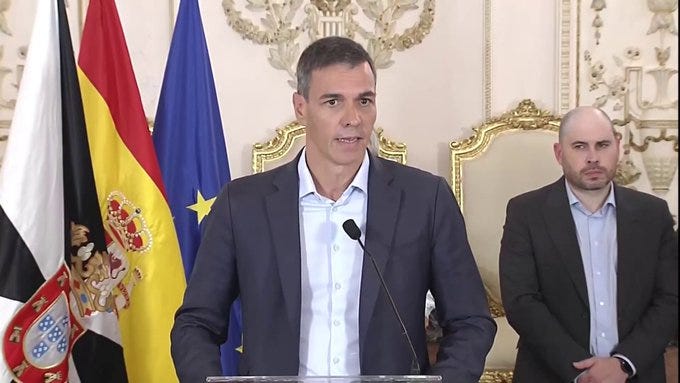
European leaders embarrassed themselves over Ceuta
Sanchez' Spain swiftly dealt with the incursion of 60,000 Moroccan migrants sent to Ceuta as part of Morocco's hybrid warfare strategy, and after showing zero solidarity, anti-EU leaders backed down.

👋Hey guys, Julien here. The French Dispatch is a reader-supported publication, and both our coverage of current affairs as well as our ability to bring you more news and information on the world around us is entirely funded by paid subscriptions and donations.
If you enjoy reading articles written by high-level experts, then make sure to support the publication by liking, subscribing, and sharing it with your friends and colleagues, and consider taking a paid subscription.
Within 24 hours, Spain had returned the very large majority of the over 60,000 people who crossed from Morocco into Ceuta over 30 and 31 July, with, in the Council’s own assessment, no onward movement to mainland Spain or other member states.
This was a serious and genuinely impressive operational achievement: the crowd that arrived at the fence in a single day came close to Ceuta’s entire population of around 80,000. Guardia Civil and the army secured the perimeter, Madrid rapidly mobilised the extra capacity necessary to deal with the issue, and after calling the situation “unacceptable”, Commission President von der Leyen appointed two commissioners to help coordinate the European-level response, an acknowledgement that this was a shared European problem rather than a Spanish one.
And yet, as we’re used to by now, none of that stopped several fellow EU governments from treating Madrid, rather than Rabat, as the problem, with the common denominator being a right-wing lean and political desperation.
Zero solidarity, while the toll climbed
Within 24 hours of the breakthrough, and after the situation had effectively come to an end, Italy had imposed border checks on travellers arriving from Spain, and by the end of the week Italian officials were floating shutting Spain out of Schengen altogether.
France’s interior minister, meanwhile, ordered extra checks along the Pyrenees, a moderate step compared with what came next. Jordan Bardella, whose far-right Patriots for Europe group sits well to the right of most national governments in Brussels, wrote to Parliament President Roberta Metsola demanding an emergency debate on what he called the “failure of the European Union’s migration policies”.
Nigel Farage, that strange British man who made Brexit happen and who is allergic to both accountability and geography, told his own followers the crossings had “invaded” Ceuta, and warned, inaccurately, that the people involved would soon be crossing the Channel into Britain, a country that is not in Schengen and roughly a thousand kilometres from Ceuta.

And to add to the dramatic effect: some silly people from Fox News decided that Ceuta was actually in northern Spain, somewhere near Navarra and the Basque Country, because why not just transpose northern Africa into Europe for the sake of some clickbait and political capital.
By the time Pedro Sánchez called the reaction a “selfish, polarising and unlawful” response from European allies, the confirmed death toll of what appears to have been either hybrid warfare or sheer incompetence from the Moroccan government, had already risen from 67 on Friday to 72 by Sunday, according to Spain’s government delegate to Ceuta; the region’s own morgue reported 88 bodies received, while Morocco’s interior ministry, working from its own figures, confirmed just 11.
He was right, and the following week proved it.
A crisis made in Rabat, not Madrid
Why this looks like hybrid warfare, not a migration failure
Morocco has used the Ceuta crossing point to pressure Madrid before. In May 2021, Rabat eased its border controls for two days after Spain treated Polisario Front leader Brahim Ghali in hospital without prior notice, and roughly 8,000 people crossed in 48 hours. Spain’s own defence minister called it blackmail at the time.
Within a year, Madrid had abandoned its neutrality on Western Sahara in favour of Morocco’s autonomy plan, a reversal widely read as the price of that episode. Rabat denies engineering July’s crossing and blames overwhelmed local police instead. The scale, the timing, and Moroccan forces standing down at the fence for the second time in five years make that denial hard to credit.
I’m not alone in reading this abhorrent situation this way. The European Council on Foreign Relations warned that failing to back Spain risks “encouraging Morocco and others to keep using migration as a tool of coercion”. Seen against that backdrop, Italy’s border checks and Bardella’s letter amounted to a reward for Rabat, delivered for free, by politicians who call themselves defenders of Europe’s borders and people, all while undermining the one member state that was actually single-handedly doing this while being stabbed in the back.
A four-day climbdown
By 4 August, when Irish minister Jim O’Callaghan convened an informal video conference of EU home affairs ministers, the ridiculous anti-Spanish posture had been completely reversed.
The same bloc that could not be bothered to show solidarity four days earlier now recorded that member states were united in expressing strong solidarity with Spain, commending the “swift and effective” Spanish response. Italy’s border checks were quietly dropped, and Bardella’s promised emergency debate never happened.
Notably, nobody but the most ridiculous far-right influencers brought up Schengen suspension again.
This reversal took four days and needed no real debate. Governments that were imposing border checks and floating Schengen suspension on 1 August were praising Spanish competence by the 4th, presumably because basic common sense and geographical knowledge were discovered.
The rising death toll and evidence of this being Morocco’s hybrid warfare against our Union also helped to go some way in rendering the original position politically untenable.
But, regardless of the positive result, we need to call it what it is: a cowardly climbdown, staged in public, by right-wing and panicked governments that picked the wrong target, used the wrong logic, and then had to unpick their own words on the record.
Knowing and not saying
Ministers committed to reinforcing returns and deepening partnerships with third countries, the same language used after every previous Ceuta crisis, and deferred anything harder to a further ministerial meeting and the European Council in October, ten weeks away.
Morocco is not named once in the readout, with this omission looking less like an information gap than a decision. Spanish media reported, citing security sources, that the National Intelligence Centre had warned the Interior Ministry several times of a possible mass crossing in the weeks beforehand, tied to Morocco’s Throne Day, but Interior Minister Fernando Grande-Marlaska has denied receiving any warning of a surge on that scale.
Either way, a Council communiqué drafted days after that story broke, and that still avoids the word Morocco, reads like a choice to keep a fragile but necessary relationship out of the public record rather than a genuine gap in what ministers understood.
No minister mentioned the Crisis and Force Majeure Regulation, the EU’s own framework for member states facing migration deliberately instrumentalised by a third state. Its relevant provisions became applicable on 1 July 2026, four weeks before Ceuta.
The Anti-Coercion Instrument is often raised alongside it, but that tool is built around trade and economic coercion rather than migration, a stretch to invoke here even though Brussels has spent this year weighing its first-ever use against Washington over Greenland. The instrumentalisation framework requires no such stretch: it exists for precisely this scenario, and nobody in the room on 4 August used it, or the word it was built to describe.
Spain’s bilateral dependence on Rabat, the same dependence that let a border be opened and closed like a tap in 2021 and again this July, is not on the table for reform either.
The anti-EU camp has humiliated itself into silence, and deservedly so. Rabat, the actual author of the crisis, has not yet been asked to answer for anything.
Not only this, but our Commission President, Ursula von der Leyen, has embarrassed herself as much as any of them.
That silence did not start with the ministers. The day before they convened, she had already answered the accountability question herself, in writing. Sánchez had complained privately to the Commission president on Saturday about the lack of solidarity from fellow member states; her reply, seen by Reuters, did not raise Rabat’s conduct at all. She, instead, proposed rewarding it.
Von der Leyen called Morocco “an important strategic partner” and offered to enhance early-warning systems and increase technical and financial support to the same government suspected of directing sixty thousand people into a crossing that had, by Monday, killed at least seventy-two of them. The Commission president who had called the crisis unacceptable on Friday spent Monday drafting a bigger cheque for the state she was too careful to name as its cause.
This is not diplomacy. It is reward.
She did not mention fisheries access under the EU-Morocco partnership, or attaching conditions to the cooperation funding Rabat already receives, both tools TFD flagged after the 2021 crisis. Nor did she raise the instrumentalisation framework her own Commission spent two years building for precisely this situation.
Every government that attacked Spain in public has already had to eat its words, in public, at the ministerial table. Von der Leyen never attacked anyone, and has faced no reckoning at all, because writing a cheque does not generate headlines the way a Schengen threat does. She had the authority to make Rabat pay for this. She chose to pay Rabat instead.
Thank you for reading the French Dispatch! If you liked what you read, you should like this post and subscribe to the newsletter by clicking/tapping the button below:
And if you’d like to contribute a coffee or two to help fuel my coverage of the wild world of politics, feel free to click on the picture below:


