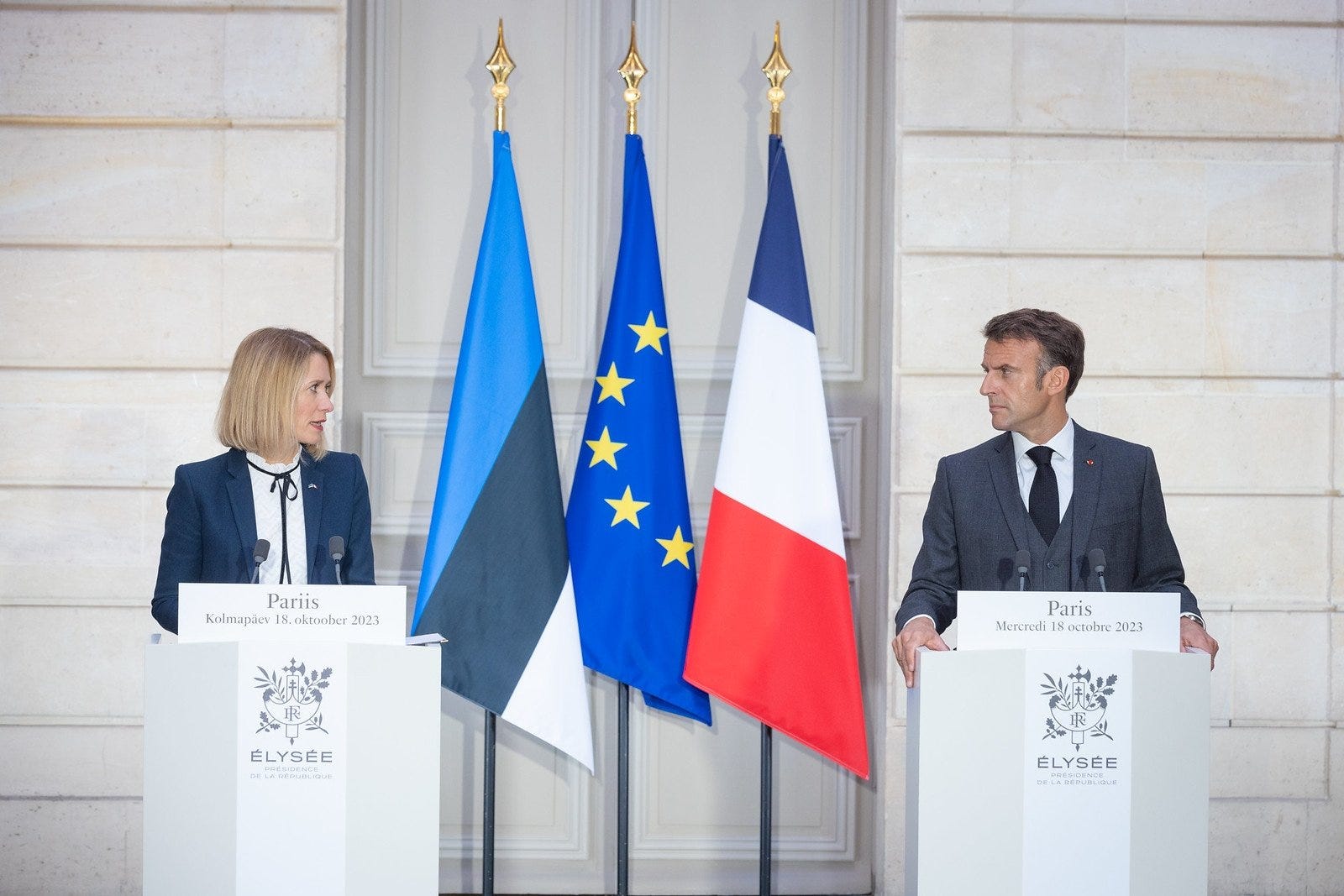
The EEAS Isn't Broken. The System Is.
France and Germany want to gut the EEAS, but dismantling the EU's diplomatic service won't fix EU foreign policy. The problem is structural.

👋Hey guys, Julien here. The French Dispatch is a reader-supported publication, and both our coverage of current affairs as well as our ability to bring you more news and information on the world around us is entirely funded by paid subscriptions and donations.
If you enjoy reading articles written by high-level experts, then make sure to support the publication by liking, subscribing, and sharing it with your friends and colleagues, and consider taking a paid subscription.
The Financial Times reported this morning that Paris and Berlin are in active discussions to overhaul, and potentially gut, the European External Action Service.
According to five senior officials briefed on the process, options on the table include stripping powers from Kaja Kallas and redistributing them between the Commission and member states, limiting her control over the EU’s network of more than 140 delegations, and shifting core functions like sanctions drafting and military mission proposals to the Council.
The Élysée has reportedly been circulating a preliminary assessment among capitals. The German government responded with its trademark blend of ambition and evasion: “We continue to strive for improving our decision-making processes.”
Translation: Ja.
The frustration driving all of this is real. The EEAS was formally launched on 1 January 2011, created by the Treaty of Lisbon to give the EU a coherent foreign policy voice, pooling diplomatic functions that had been scattered between the Commission and the Council Secretariat. Fifteen years later, nobody is satisfied.
Not the member states, who complain of too much overlap and too little coordination. Not the Commission, which under von der Leyen has steadily encroached on foreign and security territory it considers its own. Not even Kallas, who responded to the FT report with a note to staff that is best read as a diplomatic acknowledgement that yes, the system could work better.
The question is whether tearing the EEAS apart and redistributing its functions addresses the underlying problem, or reshuffles the pieces into a different kind of dysfunction.
How we got here
The EEAS was always a compromise architecture. Although the Lisbon Treaty provided the legal basis for its establishment, it provided no concrete guidelines regarding its competencies. Its architects had the difficult and politically sensitive task of creating a new bureaucratic actor not from scratch but from other bits of the EU bureaucracy.
It was created to support the High Representative, a role that is itself a compromise: simultaneously an EU foreign minister and a Vice-President of the Commission, accountable to both member states through the Foreign Affairs Council and to the Commission. The institutional design is deliberately ambiguous. Lisbon’s architects wanted a stronger EU foreign policy voice but could not agree on who would control it.
So they built a service that answers to everyone, and to no one in particular.
The High Representative of the Union for Foreign Affairs and Security Policy is one of the more unusual roles in any democratic system. Created by the Treaty of Amsterdam in 1999 and significantly expanded by Lisbon in 2009, the position was designed to bridge two institutional worlds that operate on fundamentally different logics: the intergovernmental Foreign Affairs Council, where she chairs 27 foreign ministers and is expected to reflect their collective position, and the European Commission, a supranational body with its own mandate and its own institutional interests to defend.
The EEAS, which the HR controls, sits entirely outside both institutions: not a Commission directorate, not a Council body, but an autonomous service with its own budget, its own staff, and an uncertain place in the ecosystem.
The double-hatted job nobody can do
The pattern across all four holders of the role makes the structural problem plain.
Catherine Ashton, the first HR, was criticised for being too cautious and too invisible, a Brussels apparatchik in a role that demanded a political heavyweight.
Federica Mogherini was accused of drifting too close to the Commission line, of being too accommodating toward Iran during the nuclear deal negotiations, and, most damagingly in retrospect, of systematic weakness toward Russia at precisely the moment when a harder line was needed. Her tenure coincided with the annexation of Crimea and the early years of the Donbas conflict; the EU’s response was hesitant, divided, and ultimately inadequate.
Josep Borrell brought more energy and more willingness to speak plainly, but his catastrophic visit to Moscow in February 2021, during which Russia announced the expulsion of three EU diplomats while the joint press conference with Lavrov was still underway, came to define his tenure. MEPs called it a “predictable mistake” and a “complete disaster.”
Kaja Kallas arrived with impeccable credentials on Russia, having governed Estonia through years of Kremlin pressure, and has been the most hawkish HR in the role’s history. That hawkishness has drawn its own criticism: some member states have argued that her near-singular focus on Russia has come at the cost of bandwidth elsewhere, and her remarks on China, including comments that were widely taken out of context but nonetheless required damage control with Beijing, have left capitals questioning whether she clears positions with member states before speaking.
The criticism changes with each holder. The structural conditions that produce it do not.
The current wave of criticism reflects something baked in from the start. Kallas speaking her own mind on EU-China relations is not a character flaw; it is what happens when the person in the role actually tries to use it. The overlap between the EEAS, the Commission’s external relations directorates, and national foreign ministries is not a management failure; it is structural.
Von der Leyen did not accidentally encroach on Kallas’ territory. She did so because the treaty allows it and because the “geopolitical Commission” was a political choice that her member-state supporters broadly backed, even if out of political laziness.
The pattern has been consistent across von der Leyen's second term. She pushed out Thierry Breton in September 2024, going behind his back to ask Macron to withdraw his nomination in exchange for a more influential portfolio for France. Breton publicly accused her of "questionable governance" on his way out.
Von der Leyen also took advantage of Macron's domestic weakness following his ill-fated decision to call snap elections in 2024: with French politics in freefall under Barnier, the Élysée needed somewhere to land a close ally, and Séjourné duly arrived as an Executive Vice-President with a large prosperity and industrial strategy portfolio. Paris got its upgrade; von der Leyen got rid of the one commissioner willing to openly defy her.
Von der Leyen has since moved to establish a new intelligence cell within her own secretariat-general, duplicating the INTCEN unit already in place within the EEAS under Kallas' authority. The proposal met resistance from member states and EEAS officials and was scaled back, but the impulse behind it was clear: the consolidation of foreign and security functions inside the Berlaymont, under her direct control.
Stefan Lehne, a senior fellow at Carnegie Europe, has argued that merging the EEAS into the Commission would clarify responsibilities and reduce duplication, and that existing structures and procedures are no longer fit for purpose. He is right that reform is overdue. But the EEAS is not the explanation for the Iran war, Trump’s tariff offensive, or the fragmented European response to Russia. Those failures have deeper roots.
The stakes are immediate. According to the FT's sources, ideas for reshaping EU foreign policy structures are being factored into a new EU security strategy that von der Leyen and Kallas are working on together, and which is set to be published this summer.
Whatever institutional architecture emerges from the current discussion will likely be baked into that document. A reform driven by cost-saving and capital frustration, rather than strategic logic, risks locking in dysfunction for another decade.
The accountability gap
The institutional debate tends to dance around the real problem: accountability. The EEAS is not dysfunctional because its people are incompetent. Brussels has no shortage of capable officials. The dysfunction stems from a system that has limited autonomy, is split across the Commission and the Council, and cannot be held responsible for its decisions the way national governments can.
You cannot vote out the EEAS. You cannot fire the High Representative at the ballot box. When things go wrong, which in foreign policy they regularly do, the only available corrective mechanism is the kind of informal capital pressure that Paris and Berlin are applying right now.
The High Representative is, by design, a role shaped entirely by whoever holds it. Every few years, one turns out to be effective, and everyone acts surprised. The rest of the time, it is a target. That is not a personnel problem. It is a constitutional one: a job defined by institutional ambiguity, with no democratic mandate for its choices and no electoral accountability for its results.
Redistributing EEAS functions to the Council gives member states more direct control, yes. It also gives them more places to shift blame when the next crisis hits, and risks more gridlock without genuine treaty change to address vetoes. Shifting powers to Commission directorates does not solve the accountability gap either; it means a different set of officials who cannot be voted out and make the same decisions.
The deeper problem is that foreign policy cannot credibly be led from Brussels under current treaty arrangements. Not because Brussels lacks talent or analytical capacity, but because the entity nominally leading on foreign policy has no genuine legal mandate for its choices and remains beholden to Von der Leyen’s office and to whichever Council configuration happens to hold the relevant dossier.
Coalitions of the willing, backed by willing EU institutions, are how Europe has actually operated in every recent crisis, from Ukraine to Iran. Frustrating, perhaps, but at least it’s honest about what the current system can deliver.
The wrong surgery
What Paris and Berlin are proposing is essentially a reabsorption. The powers carved out in 2010 to build an autonomous diplomatic service would flow back to the bodies that predated it: the Council would get the harder security and sanctions work, the Commission would keep day-to-day diplomacy alongside its existing trade profile. The argument is that this reduces duplication, saves money, and makes the external action architecture less fragmented.
Some of that is probably true in narrow operational terms. The EEAS does overlap with Commission directorates. Sanctions drafting has acquired an EEAS dimension that arguably belongs in the Council. Budget pressures are real, and with the next multiannual financial framework negotiations underway, every institution with a significant headcount is a target.
But the structural problem this reshuffling attempts to address is not the problem that actually needs fixing. Pulling powers back from an autonomous service and returning them to bodies controlled more directly by member states is not reform toward a stronger European foreign policy. It is a reform toward a more intergovernmental one.
Every crisis of the past decade has demonstrated that intergovernmental coordination, while sometimes effective when big member states align, is unreliable, slow, and hostage to national political cycles. France and Germany are aligned now. They were not aligned on Ukraine for the first three years of the war. They will not always be aligned.
What the actual solution looks like
The federalist case for EU foreign policy is not, at its core, an argument about bureaucratic architecture. It is an argument about power. Europe currently punches well below its weight geographically, economically, and militarily because it acts as a collection of medium-sized states rather than as what it actually is: the largest single market on earth, home to 450 million people, with combined defence spending that would rank second globally if properly coordinated.
The gap between Europe’s resources and the geopolitical results it produces is not primarily a design problem for the EEAS.
Fixing it requires three things, none of which are on the table in the current discussion.
Treaty change and qualified majority voting. The current architecture was designed to manage foreign policy coordination between sovereign states. It was not designed to run a geopolitical power.
Any single member state can currently block any CFSP decision with its veto, regardless of how broad the consensus is among the other 26 member states. We saw this repeatedly under the previous Hungarian government of Viktor Orban, who frequently frustrated other member states with his antics.
Under qualified majority voting, 15 of 27 member states, representing 65 per cent of the EU population, would have to agree, and third countries would lose their current ability to divide the EU by instrumentalising individual members’ economic dependencies.
The 2020 Belarus sanctions were a painful illustration: the EU was slower to respond than post-Brexit Britain because Cyprus held the package hostage, linking Belarus sanctions to unrelated demands for EU action against Turkey over drilling rights in the Mediterranean. The deadlock lasted weeks and was resolved only after a political deal at the European Council.
The Commission put forward a proposal in December 2025 to enable qualified majority decision-making through legal bases outside the CFSP framework, a workaround that is heading in the right direction but does not actually get there.
Meaningful QMV in foreign policy requires treaty change, and treaty change requires the political will to have that fight.
Democratic legitimacy for foreign policy decisions. The European Parliament has almost no formal role in EU foreign and security policy. That has traditionally been defended on the grounds that security decisions require speed and confidentiality, both legitimate concerns that explain almost nothing about why parliamentary scrutiny is so weak.
Strengthening the Parliament’s oversight role, without giving it full executive authority, would go some way to closing the accountability gap that currently makes EU foreign policy institutionally rudderless.
A real EU foreign policy pole. Not a redistributed set of fragmented functions. Not a cost-saving exercise. A deliberate, treaty-backed decision to integrate the EEAS, the Commission’s external directorate, and the Council’s security apparatus under unified democratic oversight, with the resources and mandate to act as a genuine geopolitical actor. Structural integration, not structural reabsorption. The institutional infrastructure that actually matches EU ambitions to EU power requires accepting that the current system was not designed for that purpose and cannot be patched into one.
What Paris and Berlin are discussing will deliver neither. It may produce a tidier organogram and a marginally reduced budget line.
We Europeans have two options:
We can continue patching up a system designed for a completely different era, reshuffling functions between institutions that were never built to run the geopolitical juggernaut that we should be and simply hope that the next crisis finds the right coalition willing to act.
Or we can accept that genuine strategic autonomy requires genuine institutional courage: treaty change, democratic legitimacy, strong institutions, and a foreign policy entity with the mandate, resources, power and guts to match Europe’s actual weight in the world.
Blaming the High Representative for the current dysfunction is Brussels’ favourite sport, but it does nothing but embarrass us in front of our citizens and the wider world. Building the institution that would make that blame unnecessary is the harder work. It is also the only work that matters.
Thank you for reading the French Dispatch! If you liked what you read, you should like this post and subscribe to the newsletter by clicking/tapping the button below:
And if you’d like to contribute a coffee or two to help fuel my coverage of the wild world of politics, feel free to click on the picture below:


