


👋Hey guys, Julien here. The French Dispatch is a reader-supported publication, and both our coverage of current affairs as well as our ability to bring you more news and information on the world around us is entirely funded by paid subscriptions and donations.
If you enjoy reading articles written by high-level experts, then make sure to support the publication by liking, subscribing, and sharing it with your friends and colleagues, and consider taking a paid subscription.

This week
📢Unions keep the peace during second protests
🏛️Racist Trappes gunman says he was avenging the looted shops
📢Unions keep the peace during second protests
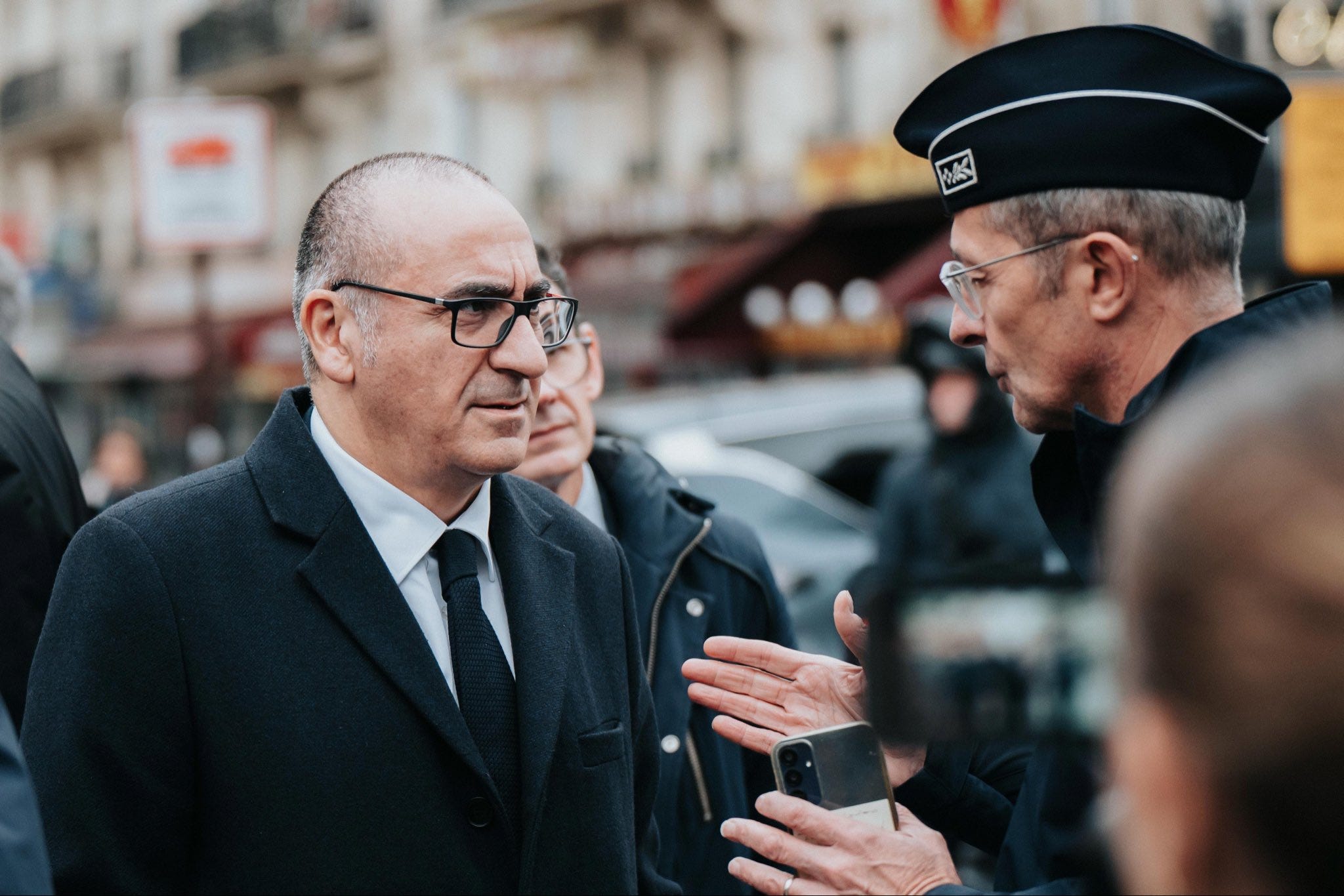
So, to focus on the big story of the week: following the carnage that broke out last week across France, a second weekend of protests took place without a repeat of the looting and violence that shocked just about everyone. Thanks to the government's insistence that only unions organise protests, and the very strong security presence, the 24 October protests were a success.
The damage from October 17th
Around 1,500 shops looted, burned or vandalised nationwide, at a cost the retail federation’s Alexandre Bompard puts at several hundred million euros. Paris mayor Emmanuel Grégoire described “entire streets methodically ravaged”.
Paris
City Hall says 451 shops were vandalised.Lyon
Over 200 shops ransacked and the tourist office burned down.Marseille
Around 300 shops looted in the city centre, with the Bouches-du-Rhône préfecture reporting 30,000 looters.Limoges
Town hall, built in 1883 and a listed historic monument, set alight and largely lost, according to the prefect.Rouen
University building burned overnight on 16-17 October.Schools
Damage to lycées put at nearly €40 million by Régions de France.Guadeloupe
Curfew for unaccompanied minors in Pointe-à-Pitre and Les Abymes.Injuries
997 police and gendarmes hurt, seven seriously. Among protesters, a 17-year-old boy lost a hand in Saint-Étienne and a 17-year-old girl lost an eye in Mulhouse, and one protester died of cardiac arrest in Paris.Arrests
2,397 nationwide by Beauvau’s consolidated count, 855 of them in Paris.
The method was simple enough. After addressing the nation in front of 16.7 million viewers last Sunday, Macron refused Laurent Nuñez’s offer to resign and told him to come up with a new strategy for dealing with rioters.
What emerged was a two-track approach: union-led marches went ahead, while non-union demonstrations were explicitly banned across six cities. Around 70,000 police and gendarmes, 20% more than last week, were deployed, alongside soldiers from the Sentinelle mission.
The high-level of arrests linked to the 17 October riots may have also helped more than a little bit.
On Saturday evening Nuñez could say that “the marches went well”, even as he complained of extremely high levels of violence against officers on the fringes of the protests. Close to 1,000 people were arrested nationwide, 142 of them in Paris, which was thankfully a fraction of the previous weekend’s tally.
The calm came at some cost to the movement, however, with the ministry counting 410,000 marchers, 110,000 in Paris. As is always the case with protests, the CGT Union disagreed with the government's claims and said it was actually 800,000 and 250,000. A week earlier the ministry’s own count was 550,000, with the same 110,000 in Paris, so on that metric the official turnout fell by about a quarter nationally and by nearly a third outside the capital.
Le Monde called it a slight drop, which is generous.
Leaning on the unions didn't stop the state from making their jobs harder, however.
On Thursday, the Île-de-France intersyndicale negotiated and signed a Bastille-Nation route with the Préfecture de police; on Friday afternoon, the Préfecture banned it and moved the march to a 5.4 km stretch of the maréchaux between Porte d’Italie and Porte de Vincennes, towards the city’s edge.
The student union Fage warned the switch “weakens the safety conditions of the demonstration”, and the tribunal administratif rejected the unions’ challenge on Saturday morning. The CGT’s Karl Ghazi told Le Monde that the Préfecture had “clearly decided to play up the tension”, but the stewards marched anyway and kept the protest calm and orderly.
Things were fairly similar in Marseille, where an agreed route steered clear of the shopping streets looted a week earlier, and the march ran for three hours without incident. Trouble began to flare only after the union stewards left. In Lyon, where the préfecture banned the march outright, around ten thousand people spent the afternoon being dispersed with tear gas for ignoring the prefectural order.
As I discussed with several news outlets during the week, the protests themselves have also morphed recently:
The movement grew out of lycéen anger over school funding and diesel at a record €2.39 a litre in late September, with the cost of living crisis having been a major problem for years now due to COVID, the Russian invasion of Ukraine, and Donald Trump’s idiotic war against Iran.
Yet Le Monde’s reporters in Paris heard little about fuel and a lot about the police and Emmanuel Macron, making this a true Gilets Jaunes protest.
Unfortunately for everyone, the government is doing its best to keep that vibe shift going: In a circulaire to prosecutors on Thursday, justice minister Gérald Darmanin asked them to seek deprivation of civic rights, the vote included, alongside protest and social media bans, wherever an offence reveals “a break with the republican pact”.
The penalty already exists under article 131-26 of the penal code, capped at five years for a délit, but framing it in such an elastic phrase is a political choice.
Tensions will likely continue, with the CFDT, CGT, FO, Unsa and FSU calling for a general strike on 5 November against €54 billion in planned budget cuts, and gilets jaunes on the Paris metro already promising an “acte III” for 31 October.
Saturday’s calm carries a bill the government has not yet read. By channelling protest through the unions, ministers have made the intersyndicale the guarantor of public order, and the unions know it.
The CFDT’s Raphaël Breton is already treating 5 November as the next stage, and the leverage seems entirely on his side: if Beauvau wants another peaceful day, it needs the stewards more than the stewards need Beauvau.
🏛️Racist Trappes gunman says he was avenging the looted shops
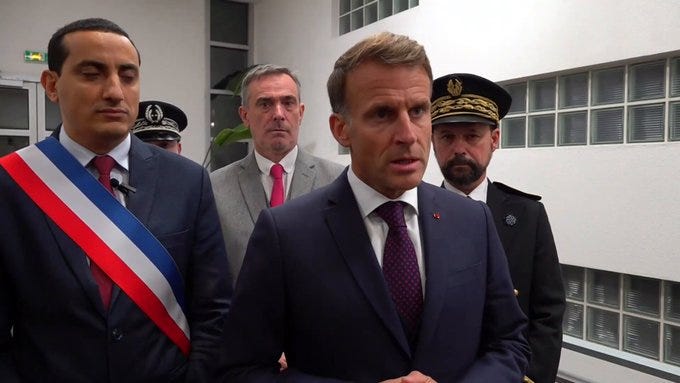
As France braced for a second weekend of protests, the week's darkest story happened Friday morning in the Yvelines. A man drove through Trappes and neighbouring La Verrière firing a submachine gun out of his car at people who weren’t white, killing one man and wounding five others, including a 12-year-old girl.
What ties this attack to everything else going on in France right now is the motive. According to Le Monde, Kévin T. told the first officers on the scene that he had “avenged the shopkeepers” looted on 17 October by targeting Black and Arab citizens. His shots, investigators say, were aimed exclusively at non-white passers-by.
Macron went to Trappes on Friday evening and didn’t mince his words, calling it a turning point and “a planned terrorist act to kill our compatriots, our children” because of their skin colour or religion. Trappes mayor Ali Rabeh (Génération.s) called it “objectively an attack, with a racist connotation, probably Islamophobic”.
The condemnations were unanimous on paper, from Lecornu to Mélenchon to Bardella, even if the tone was decidedly uneven: The left went straight for the very clear racism of the situation, while the right’s first reactions were noticeably more cautious, with Marine Le Pen initially saying the motives still had to be established. Only once the PNAT’s line was clear did she describe a terrorist act “aggravated by the abject motive of racism”.
In Trappes itself, the mood was anger more than shock. Around 200 people gathered on Saturday near the square where Pengo Bossio Wangi was shot, under a banner bearing his face and the words “Les mots tuent” (“words kill”). Rabeh, speaking at a protest against the RN’s congress in Orléans, said those who spread racist rhetoric bear part of the responsibility for having armed the gunman ideologically.
The family’s lawyer, Yassine Bouzrou, has asked investigators to map out exactly how Kévin T. was radicalised and what he was reading.
However, Macron’s “turning point” framing deserves a closer look. His claim that this is the first planned terrorist act targeting people for their skin colour or religion is simply not true. In May 2025, Hichem Miraoui, a Tunisian, was shot dead by his neighbour in Puget-sur-Argens, and the PNAT took that case too: its first homicide involving a far-right suspect, after 15 non-lethal cases since 2019. That suspect also ended up denying any racist motive once in custody.
The government spent last week insisting, through Nuñez, that the 17 October violence was the work of ultragauche militants. Kévin T. read the same images through the lens of race and the banlieues, and that reading didn't come out of nowhere: Trappes has served for over a decade as the right's shorthand for everything said to be wrong with the quartiers.
One of the major risks now is that we see an emulation of the discourse we see in the United States, with the white terrorist being positioned as an “isolated, unstable man”, a frame that stands in stark contrast to the way Black and Arab terrorists are framed, and the case is rapidly shifted from terrorism to mental illness, effectively closing the question of what fed his interpretation of 17 October.
And the worst part of this is that it feeds into the ongoing split between the far-right and far-left six months out from a presidential election, with the parties most exposed to the “words kill” charge having every incentive to let things keep spinning out of control to feed their narratives.
Thank you for reading the French Dispatch! If you liked what you read, you should like this post and subscribe to the newsletter by clicking/tapping the button below:
And if you’d like to contribute a coffee or two to help fuel my coverage of the wild world of politics, feel free to click on the picture below:
