


👋Hey guys, Julien here. The French Dispatch is a reader-supported publication, and both our coverage of current affairs as well as our ability to bring you more news and information on the world around us is entirely funded by paid subscriptions and donations.
If you enjoy reading articles written by high-level experts, then make sure to support the publication by liking, subscribing, and sharing it with your friends and colleagues, and consider taking a paid subscription.

This week
🌹French left votes in primary first round
🌿Mélenchon visits Gergovia
🧾 Bardella’s poor spelling adds to evidence
🌹French left votes in primary first round
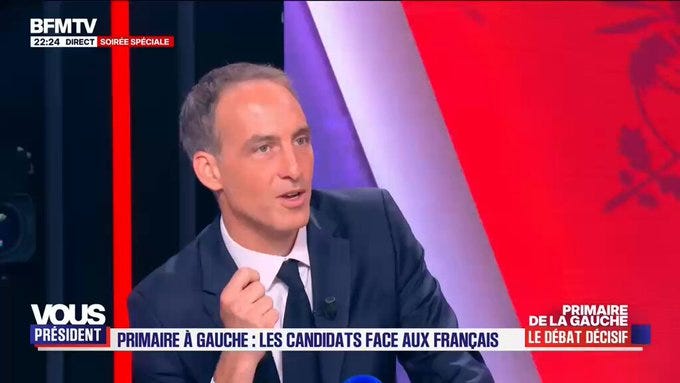
Kicking off the week with what could be a consequential event for the 2027 Presidential Elections: the French left are going to the polls today to vote on their candidate for the Elysée.
And despite the fact that, in last week’s Dispatch, we saw an Elabe poll showing that barely a quarter of the country was following the left Primary, people clearly were paying attention, and not just militants.
To begin with, the electronic ballot run by the Parti Socialiste (PS), Place Publique (PP) and the Gauche Républicaine et Socialiste (GRS) came under an aggressive cyberattack the moment it opened at 08h00 on Friday, with bots swarming the e-voting platform with fake simultaneous connections until legitimate voters could barely get through.
The attack was so successful that, by 19h00, only 20,000 of the 140,000 registered had managed to cast a ballot, so the committee, chaired by Patrick Mennucci, pushed the closing of the first round of voting from 20h00 on Saturday to 18h00 Sunday, while the three parties took the matter to court and Sébastien Lecornu reportedly called in ANSSI, the French cybersecurity agency.
Mennucci’s account of events grew steadily more dramatic as the weekend went on and details became more concrete: On Friday evening, he told AFP that everything was back in order, but by Sunday he was telling La Tribune Dimanche that e-votez, which he described as the leading provider in France, had never faced an offensive on this scale, and that this was “an attack on French democracy” reaching well beyond a Socialist primary.
Considering how vocal Raphael Glucksmann has been about supporting Ukraine, I’m sure we can all guess who was behind this.
In the same interview, Mennucci assured readers that no bot had managed to vote and that the whole episode was not a failure, two reassurances organisers tend to offer only after people start asking some harder questions.
Thankfully, once the issues were resolved, voter turnout recovered, and by 14h00 on Saturday 91,470 people had voted; by 08h00 on Sunday, the organisers counted 110,709.
Close to 80% of all the registered voters, with ten hours left to vote, from an electorate that had already comfortably exceeded the 90,000 registrants originally forecast. Whatever the rest of the country thinks, or whatever the polls have shown us, the faithful showed up.
MEP Raphaël Glucksmann (Place Publique) goes in as the favourite with polling numbers that have consistently put him in competition with Attal (REN) and Mélenchon (LFI). The PS First Secretary Olivier Faure is his main challenger, with Ségolène Royal, Jérôme Guedj and Emmanuel Maurel filling out the rest of the field.
Results are due this evening, with a run-off on 16 and 17 October if nobody clears 50%.
The turnout figure flatters the exercise, mind you, because the register was kept small on purpose. Anyone outside the three organising parties had to sign up on a platform called Choisir2027 and pay €15 for the privilege. The fee, cut to €10 for those on low incomes, has been criticised for tilting the electorate towards Glucksmann’s ‘better-off’ supporters.
Above all else, it was a curious entry price for a camp that spends most of its time talking about the cost of living and is battling La France Insoumise and the far-left for the working-class vote.
The open primary that picked François Hollande in 2011 drew between 2.6 and 2.8 million voters at €1 a head, and even the 2017 edition that handed the nomination to Benoît Hamon managed around 1.6 million. This year’s entire register is roughly 5% of the 2011 turnout, and if tonight’s margin is tight, the runner-up already has a ready-made grievance about a ballot under attack from its first minute.
But there are also strong reasons for concern with how the left-wing primary appears to show a still-fragile PS that may struggle to fight Mélenchon.
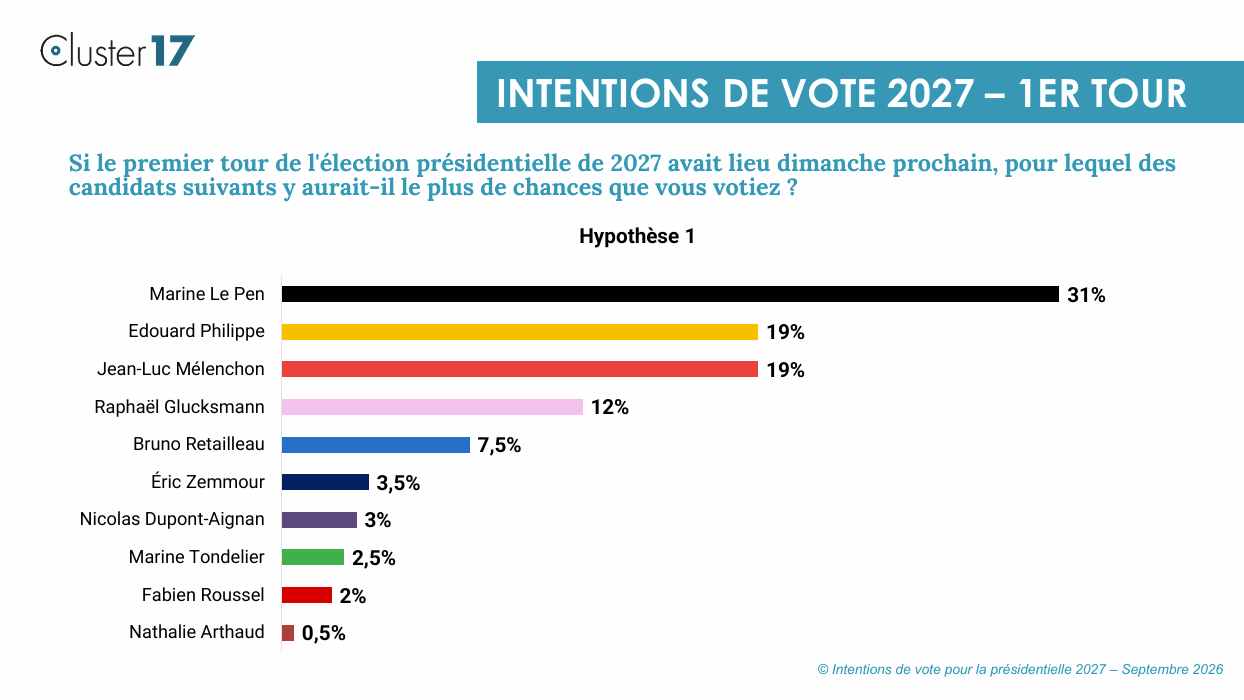
The stakes tonight go well beyond Solférino, and whoever wins inherits the job of overtaking Jean-Luc Mélenchon as the left’s leading candidate, with some polls showing it to be a steep climb: Cluster 17’s mid-September survey for Politico had Mélenchon on 19%, level with Édouard Philippe, with Glucksmann on 12 to 14% and Marine Le Pen far ahead on 30 to 31%.
A Glucksmann win would put the centre-left’s best-polling figure at the head of the PS machine and its money, while an upset by Faure would hand the nomination to the party apparatus over the man pollsters have been testing all year, and Mélenchon’s case for the useful vote on the left would more or less write itself.
Plus, we’d likely see another 5 years of a very submissive PS.
Fun fact of the day: today is also the day Marine Tondelier’s Ecologists and François Ruffin’s Debout! hold their own unitary primary between the two politicians, so by Monday morning the non-Mélenchon left will have two freshly anointed candidates and no mechanism for choosing between them aside from common sense.
What we do know is that, since Elabe found last week that 73% of PS-PP sympathisants reject any legislative alliance with LFI, whatever deal emerges will be struck without Mélenchon, which is precisely how he likes it.
🌿Mélenchon visits Gergovia
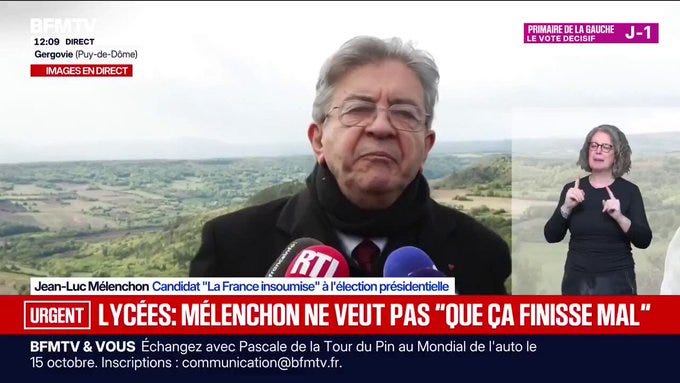
Speaking of the devil: while the centre-left was busy fending off bots, Jean-Luc Mélenchon (LFI) spent his Saturday on a history field trip.
Mélenchon made his third pilgrimage to the plateau of Gergovia, 750 metres up in the Puy-de-Dôme, where the Gauls handed Julius Caesar his first military defeat in 52 BC. The point of the visit was to tie the war of movement, the tactic Caesar was famous for, to his own leadership in turning La France Insoumise into one of the most disruptive forces in French politics.
Oddly enough, for a man standing on the site of a great Gaulish victory, he sided with the Romans, telling museum staff he admires them more as soldiers because the Gauls were too disorderly for his taste. In short, Mélenchon wants a party that never stands still and constantly pushes toward the next crisis or event it can exploit.
We’ve seen this in recent weeks, first with his push to cancel part of the French debt and pick a fight with our European partners, and then with the lycée blockades.
To begin with, cancelling French debt is one of his flagship plans, first aired in late June: take the 18% of French debt held by the Banque de France and throw it on the fire, on the incredible assumption that nobody would ever notice it was gone. When he later switched to asking the European Central Bank (ECB) to put Covid-era debt in the freezer, economist Xavier Ragot pointed out that this would run straight into the EU treaties guaranteeing the bank’s independence, a detail LFI seems content to leave for later.
Naturally, it also fits the line Mélenchon has held through his last two presidential campaigns: hostile to the EU treaties, and to NATO on top of that.
Somewhere in Frankfurt, someone is presumably still laughing while the Euronext president tries to avoid a heart attack: “He’s either mistaken if he doesn’t know how it works, or he’s lying if he does.”
The lycéens, meanwhile, are the high-school blockades that Prime Minister Sébastien Lecornu’s office blames on LFI and its far-left proxies, accusations that came after 1,747 arrests on Friday 2 October alone and more than 5,000 over the week. LFI coordinator Manuel Bompard fired back that Matignon was sliding into conspiracy theories and insisted LFI had nothing to do with it, even though Mélenchon has made little effort to hide his enthusiasm for the movement.
Both are textbook examples of Mélenchon’s long-term strategy: highly politicised situations where dissent spills over into confrontation with state institutions, in this case blockades marred by violence and thousands of arrests.
And it is the strategy working exactly as designed, with LFI dragging the agenda wherever it likes and everyone else chasing after it and trying to repair the structural damage left behind.
But has his strategy actually paid off?
His 19% in the Cluster 17 poll above puts him close to his 2022 score, when 21.95% left him barely more than a point short of the run-off. His route to the second round depends on the rest of the left staying fragmented enough for him to remain the only credible option, and on his ability to keep it that way.
As long as the debt and the lycéens dominate the headlines (which, to be clear, they likely will not), Glucksmann, Faure and Tondelier have to spend their time reacting to him instead of setting their own terms, which is exactly the political battle he prefers.
Even if these rows fade, Mélenchon will keep pushing for more protests as long as he finds them useful. He has already described the 6 October mobilisation as a starting point for the lycée movement, and the 2027 budget’s passage through Parliament this autumn hands him a running platform for the debt plan and for the “abandonment of education and students”.
And once tonight’s result is in, LFI will also have a named rival to attack.
🧾 Bardella’s poor spelling adds to evidence
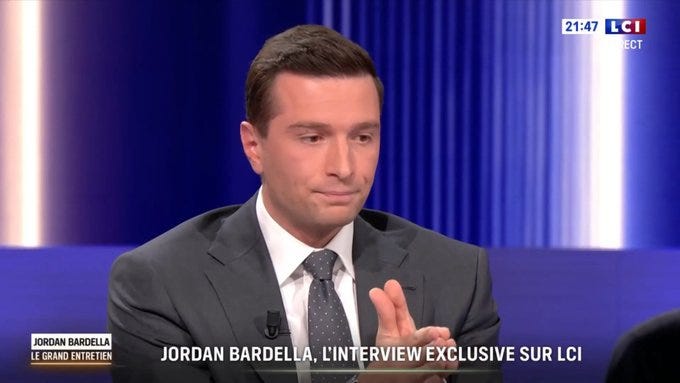
Moving on to the other extreme: Last week, we left Jordan Bardella (RN) calling Mediapart’s evidence of his antisemitism crude forgeries, and this week he stopped answering Mediapart completely and is now hiding behind his lawyer.
And it’s not because he’s doing so well.
On Friday, Mediapart revealed that at 22h52 on 12 September 2013, the eve of Bardella’s 18th birthday, the Messenger account attributed to Bardella told its correspondent it had just discovered online that Emmanuel Macron, then deputy secretary-general at the Élysée, had worked for the Rothschild bank.
The fact itself was true and had been public for a year, but the Rothschild name has long been a staple of antisemitic conspiracy theories about Jewish control of finance, and the message sits in the very conversation that contains the antisemitic remarks. Two minutes earlier, Bardella’s own Twitter account posted the same scoop, and both messages share the same spelling mistake: the first h is missing from Rothschild.
Ironically, while RN figures had argued that the spelling was so dreadfully bad that the messages could not possibly be his, these mistakes have now become some of the best evidence that these messages are his.
Before Bardella and Co could even think of fighting back, Le Canard enchaîné piled in. On Tuesday, Bardella told journalists he gave up Facebook a long time ago, but according to the Canard, he recently went out of his way to clean out a second account, deleting all the messages that had still been there on 28 September, when Mediapart’s first story ran.
So, on top of all of the above, Bardella seems to have deleted every single message on this second account by 2 October, and when pressed for a reply, the RN simply insisted, “Jordan Bardella has never logged into any Facebook account”.
Someone should probably show the RN’s press office a recording of Tuesday’s press conference.
The worst part is that all Bardella is doing is creating more reasons for more information to come out. His defamation complaint may yet backfire, since an investigating judge can requisition Meta and demand they establish who was behind the account. On top of all of this, and back to the politics of it all, the centre-right voters that the RN desperately needs in a second round are watching their leaders split: Justice Minister Gérald Darmanin accused Bardella of lying shamelessly, while Bruno Retailleau (LR) said he would wait for the courts.
But for now, the RN militants seem only interested in heading to Orléans for the RN congress on 24 and 25 October, where Bardella is the only candidate for re-election. Expect a coronation staged as an act of defiance, and keep an eye on the blank vote.
Thank you for reading the French Dispatch! If you liked what you read, you should like this post and subscribe to the newsletter by clicking/tapping the button below:
And if you’d like to contribute a coffee or two to help fuel my coverage of the wild world of politics, feel free to click on the picture below:

Hi Julien - thank you for continually making the wooly French political system clearer for us. 👍🙏
Doesn’t Melenchon also lean towards Russia & does not really care about Ukraine? A follower of his I tried to have a conversation with insisted the fables that Putin trots out about Ukraine are true - Ukraine “belongs” to Russia & Ukraine started the war. 😳😡