


👋Hey guys, Julien here. The French Dispatch is a reader-supported publication, and both our coverage of current affairs as well as our ability to bring you more news and information on the world around us is entirely funded by paid subscriptions and donations.
If you enjoy reading articles written by high-level experts, then make sure to support the publication by liking, subscribing, and sharing it with your friends and colleagues, and consider taking a paid subscription.

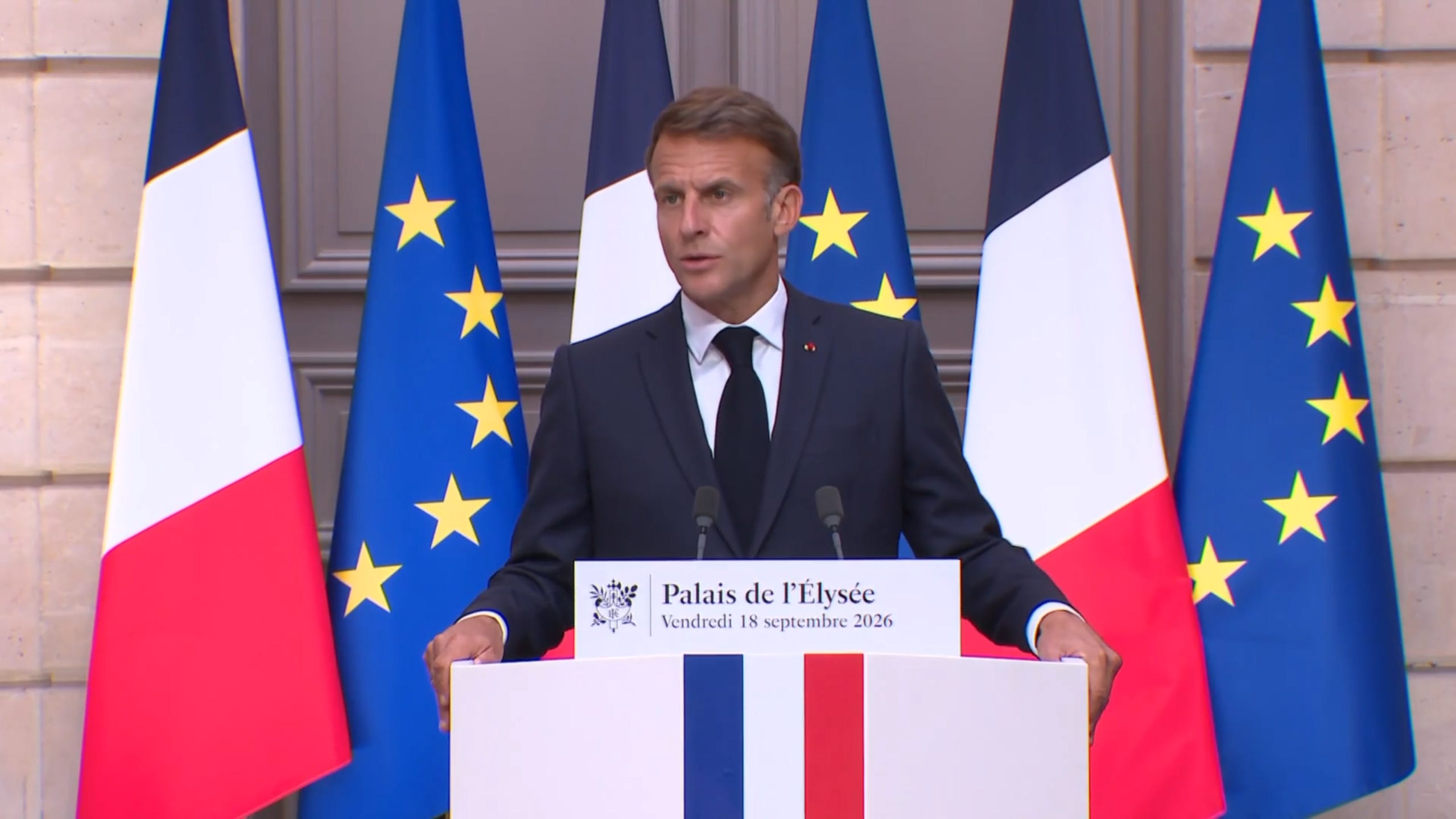
Editor note: This is a translation of the speech transcript published by the Elysée on 18 September 2026
Prime Minister, ladies and gentlemen, thank you very much for being here. I wanted to give you an account and answer your questions at the end of this meeting, which we wished to hold with the Prime Minister, by inviting all the political forces represented in the National Assembly and the Senate, and their candidates, to discuss the situation our country is experiencing today and the very direct consequences for the lives of our compatriotes of the international situation.
To that end, the Director General of External Security, the Director General of Internal Security, the Director of Military Intelligence and the Secretary General for Defence and National Security, as well as the Director General of Energy, were able to give a detailed update on the two major crises that are shaking our country and all the nations of the world.
The first crisis: the primary consequences are those of the Russian war of aggression in Ukraine. We know this situation in its most intense phase since February 2022, but in recent weeks the threat, in particular the Russian hybrid threat towards Europeans and France, has intensified. In Ukraine, as you know, the war is, every month, very deadly, with losses on both sides that are considerable and with no contemporary equivalent. You are of course familiar with the position of France and the Europeans in support of Ukraine, sanctioning Russia; I will not go back over it. But since this summer, Russia has multiplied its attacks against European interests. I was able here, on several occasions, remember the alert sounded in February 2024, calling on Europeans to gain in strategic ambiguity, announcing what we were going to do a year later with the coalition of the willing. I want to say here that the nature of Russian aggressiveness and of these threats in Europe is changing. The drone attack on a passenger train from Kyiv, a few days ago, the attempted attack at Leipzig airport, which failed, but it is because it failed that there were so few consequences, attributed by the German services to the GRU, the firing of a flare close to a Danish frigate, incursions into airspace in several European countries and the multiplication of hostile acts in most of our countries.
The DRM and the SGDSN, as well as the DGSI, were able to present the state of the hybrid attacks to which our country has been subjected in recent weeks in the face of these situations. Our position is clear: support for Ukraine is more indispensable than ever because it is the condition of our security and of a return to a just and lasting peace. That is the position that remains; it is also the one that leads us, with the United Kingdom, to steer this coalition of the willing, and indeed to hold, in a few weeks, exercises that will be conducted on European soil to consolidate it. It is also what justified the meeting on 13 July last, the new coalition and the new components that France is delivering, like other countries, to the Ukrainians.
On the domestic threat, we held a Defence and National Security Council last Wednesday, at the end of which the Prime Minister was able to give a set of instructions to his ministers and his departments. At our request, the Minister of the Interior convened all the zone prefects yesterday to raise the posture and vigilance with regard to Russian hybrid attacks, and asked the government to prepare a plan to protect our critical infrastructure, as well as the most sensitive sites of our defence industrial and technological base, against drone attacks and cyber attacks. Beyond this legitimate raising of our posture, on which we have informed the political forces and given the details, we are also continuing the work begun several months ago to improve our protection against foreign interference and cyber attacks. France was one of the first countries in Europe to organise itself in this area, creating VIGINUM five years ago now, developing its practices, coming to the aid of Romania or Moldova, to cite only a few examples, when they were attacked. We have drawn up new texts on foreign interference as well as on cyber, which will continue their legislative path as quickly as we can so that they are fully applicable in the coming weeks. Beyond that, several regulatory measures have been taken and will continue to be taken in this area. There was a long debate and many questions and answers on the question of interference during the exchange with the political forces.
The second crisis we are living through is the consequences of the war in the Near and Middle East and, in particular, the consequences for the price of energy and for the lives of our compatriotes. No one here is unaware of what so many of our compatriotes, so many families, have been experiencing in recent weeks, during which the price of fuel has risen sharply. Pump prices are reaching historic levels that today cause a great deal of suffering, that worsen the problems of purchasing power; concern is rising over gas prices and the energy situation. This situation is due entirely to the wars and the international situation. That is also the purpose of this meeting. And it is in particular due, since the war in Ukraine has been going on for four years, to the closure of the Strait of Hormuz and to the consequences of the attacks that were launched by the United States of America and Israel in Iran. As you know, this war, France did not choose it. Moreover, it did not take part in it. But, like many other countries, we are living with the consequences of what it triggered. The Strait of Hormuz remains almost blocked. In any case, there is no agreement that would allow things to reopen and, today, transit has deteriorated compared with the situation a few weeks ago. Bypass routes had been found, such as the pipeline in Saudi Arabia leading to Yanbu, on the Red Sea, which had made it possible to transfer several million barrels a day, the equivalent. Today, after the Houthi attacks on Yanbu, these volumes have also fallen sharply.
This situation, to which is added the destruction of energy infrastructure in Russia and in Ukraine, a consequence of the Russian war of aggression, has led to an explosion in energy prices everywhere in the world. Crude, diesel, all refined and processed products, so diesel or jet fuel, but also tension on gas for today and for tomorrow. This situation is obviously the one that we are experiencing and that our compatriotes are experiencing, but also the one that will continue, in the coming weeks, to set the rhythm of the country’s life. So, we were able to share our analysis, but also the actions we are taking. Today, France is doing everything to facilitate the peaceful reopening of the Strait of Hormuz. That is the action that, as early as last April, we conducted right here, by bringing together for the first time this defensive international mission with the International Maritime Organization, to make it possible, as soon as an agreement is found, to escort tankers and container ships, which would allow Hormuz to be reopened peacefully. This depends on the ability to finalise an agreement between Iran and the United States of America, which seems to us unlikely in the short term. Nevertheless, there are discussions, which we are supporting, between Oman and Iran, and there too there are diplomatic paths that would allow this strait to be reopened, and we are therefore ready to support that and to secure traffic.
The second action we are carrying out is to secure our volumes and our supplies in the most sensitive categories, where there may have been tensions as early as this summer, I am thinking of jet fuel, which affected many dependent countries, and of gas, which may affect Europeans this winter, even though France, for its part, is at the expected good level of storage and will achieve for this winter the filling of the tanks as we must do under the European criteria, that is to say we will be at 80%, but Europe as such remains more dependent on gas than France itself, and so we must act to ensure there are no tensions on this market. And so diesel, jet fuel and gas are our priority.
In that respect, this has been the heart of the diplomatic action I have been able to conduct in recent weeks, by receiving here the Prime Minister of Saudi Arabia, the Crown Prince, Mohammed bin Salman, who is of course a major supplier, by working together on solutions to secure the extraction, production and outflow of fossil hydrocarbons and our supply. It is also in that respect that I received a few days ago the Iraqi Prime Minister, with whom we signed agreements to secure our volumes and our supplies for today and for the years to come, and with whom we also worked on several oil and gas projects. That is what was at the heart of my discussions with the Emir of Qatar and with the President of the United Arab Emirates, two major suppliers. It is also what I was able to discuss yesterday with the President of Nigeria, who is also one of our major suppliers of hydrocarbons. All these initiatives are intended to secure, in the short term, our supplies in the most critical categories that I mentioned.
Alongside this, we have accelerated the work launched by France with a few others for several months, even several years, to multiply energy corridors and reduce our dependencies. That is what we had launched with India as early as its G20 and what we have accelerated in recent months, in particular within the framework of the G7 that France organised, by inviting the countries concerned. So we have work under way to organise pipelines from Iraq to the eastern Mediterranean, in order to secure the outflow of this gas. Our energy players are part of these coalitions and we were able to return to this with the Iraqi Prime Minister on Monday, and yesterday with the King of Jordan and with President Aoun, Jordan and Lebanon being, alongside Syria, among the critical countries for securing this outflow of Iraqi gas. It is also what leads us to work with Saudi Arabia and Egypt to enable the transport of other gas capacities or refined products from the Gulf countries to the eastern Mediterranean. All of these projects, we will of course continue to accelerate, but it has also been at the heart of our diplomatic action in recent days and weeks. As early as Sunday, I will also meet the Prime Minister of Canada, Mark Carney, in Saint-Pierre-et-Miquelon, to strengthen our trade in petroleum products and liquefied natural gas. So you can see that, beyond doing everything to reopen Hormuz and take part in the diplomatic efforts, the second axis of international effort is to secure our supplies to prepare for the coming weeks and months, to do the maximum to try to bring prices down and to work on alternative routes to reduce our dependence on Hormuz.
Beyond this work, France, which chairs the G7, will have to take several initiatives and I will convene a G7 to advance on better coordination of stock levels, with greater cooperation also on exports and production capacities. In the coming weeks we will have a G7 devoted to these energy subjects, both to increase cooperation and to avoid unnecessary tensions between the G7 countries and our main partners, and also to consider the options for the potential release of strategic stocks or unblocking, as we did, moreover, a few months ago with our partners, in close liaison with the International Energy Agency.
In an exceptional period, exceptional measures: we also want to act at European level. That is why, as of today, I am going to refer the matter to the President of the European Commission, first to accelerate work on gas storage at European level, then to be able to accelerate all possible flexibilities to lower our prices and the structure of our energy prices, and to do everything, obviously, to maintain both our import and our refining capacities. In this respect, I will therefore address in this referral several lines of effort to free up our production capacities, work on all possible flexibilities, facilitate the use of biofuel where technically possible, a series of very concrete measures that can be activated quickly and that should allow us to refine faster and more, at European level to consolidate more volume and to activate flexibilities that will allow us, in the very short term, to reduce our dependencies on hydrocarbons that have become more expensive and to bring down prices for all our compatriotes. This European action is urgent and, in the coming weeks, it will be at the heart of our work with our European partners.
Finally, at national level, we want, with the Prime Minister, obviously to ensure all of our capacities of supply, import and production. The Prime Minister, in the coming hours and in particular on Monday, through a series of meetings and a government seminar, will have to coordinate national actions beyond what has already been done in several areas. Securing all our supplies on the basis of the diplomatic efforts we have just built, giving visibility, over the coming weeks and months, to all the measures precisely for managing our stocks and for fluidity to avoid load breaks, whether it concerns oil, refined products or gas, and thus securing our logistics chains and our supplies.
The second axis of effort will also be to accelerate and optimise all efforts in terms of electrification and reduction of our dependence on these hydrocarbons. The third axis of effort will be to consolidate our support measures for our compatriotes and for the major economic sectors. As you know, sector plans have already been adopted for our fishermen, our farmers and several others. These will be evaluated, if necessary adapted. They may also, in this evaluation, be modulated in terms of their components and the speed of the aid given. The Prime Minister will assess this with his ministers, as well as the support measures for our compatriotes. Here too, several mechanisms exist, but this work will make it possible to draw provisional conclusions from them and to be able to adapt them and to draw the consequences for the lives of our compatriotes, to support them in this period.
That, ladies and gentlemen, is what I wished to tell you in order to report on this meeting. It was important because the situation we are going through is serious. It is serious because of the international situation and the consequences of the wars we are suffering. And in such a context, we must first of all remain united and mobilised. We must try to deal with the problems at their root, that is to say do everything so that the primary causes are resolved and therefore try to build peace, reduce our dependencies and protect ourselves and protect our compatriotes for the winter. That is exactly what we are doing. And then, we have the support measures because the situation is hard for many French families and also for many professions. And so the government and I myself are keen to support our compatriotes in this period that I know to be so hard. I want to tell them here that we are at their side and that we will mobilise. As I said, the Prime Minister, in the hours and days to come, will carry out his work.
For my part, as early as Sunday, I will see the Prime Minister of Canada, I will see several other leaders in New York on Monday and Tuesday and I will have the opportunity, at the end of these trips, to come back before French women and men, both to report on our actions and to come back too on the coming months. I will now answer your questions.
Thank you for reading the French Dispatch! If you liked what you read, you should like this post and subscribe to the newsletter by clicking/tapping the button below:
And if you’d like to contribute a coffee or two to help fuel my coverage of the wild world of politics, feel free to click on the picture below:
