


👋Hey guys, Julien here. The French Dispatch is a reader-supported publication, and both our coverage of current affairs as well as our ability to bring you more news and information on the world around us is entirely funded by paid subscriptions and donations.
If you enjoy reading articles written by high-level experts, then make sure to support the publication by liking, subscribing, and sharing it with your friends and colleagues, and consider taking a paid subscription.

This week
📊The Glucksmann lead primary France forgot
👎Bardella falls into trap in antisemitism investigation
🇪🇸Macron’s royal banquet ambushed by Senate
📊The Glucksmann lead primary France forgot
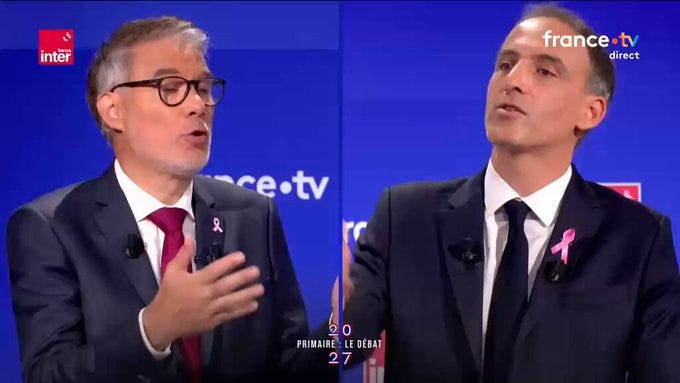
Starting the week off with a fascinating poll: it seems people are not really paying attention to the left-wing primary
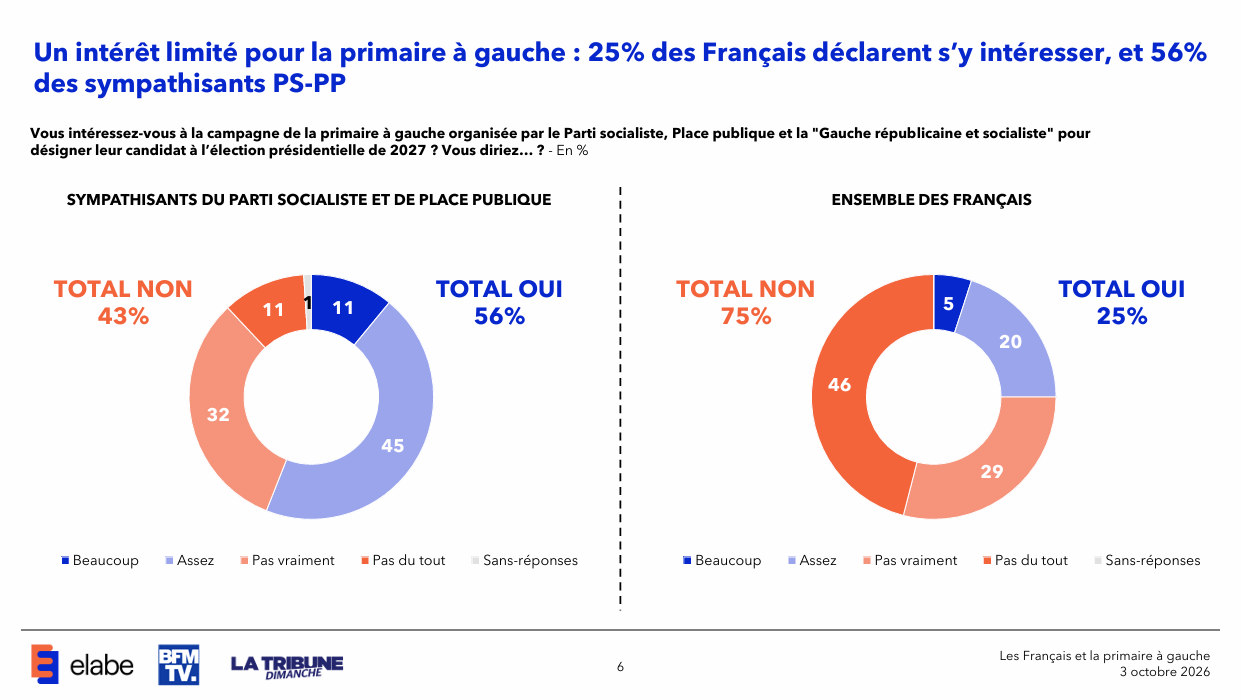
With five days to go until the PS, Place publique, and the ‘Gauche républicaine et socialiste open their electronic ballot’, Elabe has checked whether anyone outside the party has tuned in. The results aren’t great.
Turns out, only 25% of French adults say they are following the primaire, compared with 42% at the same point in the 2017 Socialist primary and 36% for the right’s contest in 2016.
The 2017 benchmark offers little comfort for anyone, given that the race that drew more interest went on to hand Benoît Hamon the PS's presidential candidacy, resulting in a calamitous 6.4% in the presidential first round. Five candidates are on the ballot (Raphaël Glucksmann, Olivier Faure, Ségolène Royal, Jérôme Guedj and Emmanuel Maurel), with a first round on 9 and 10 October and a run-off on 16 and 17 October.
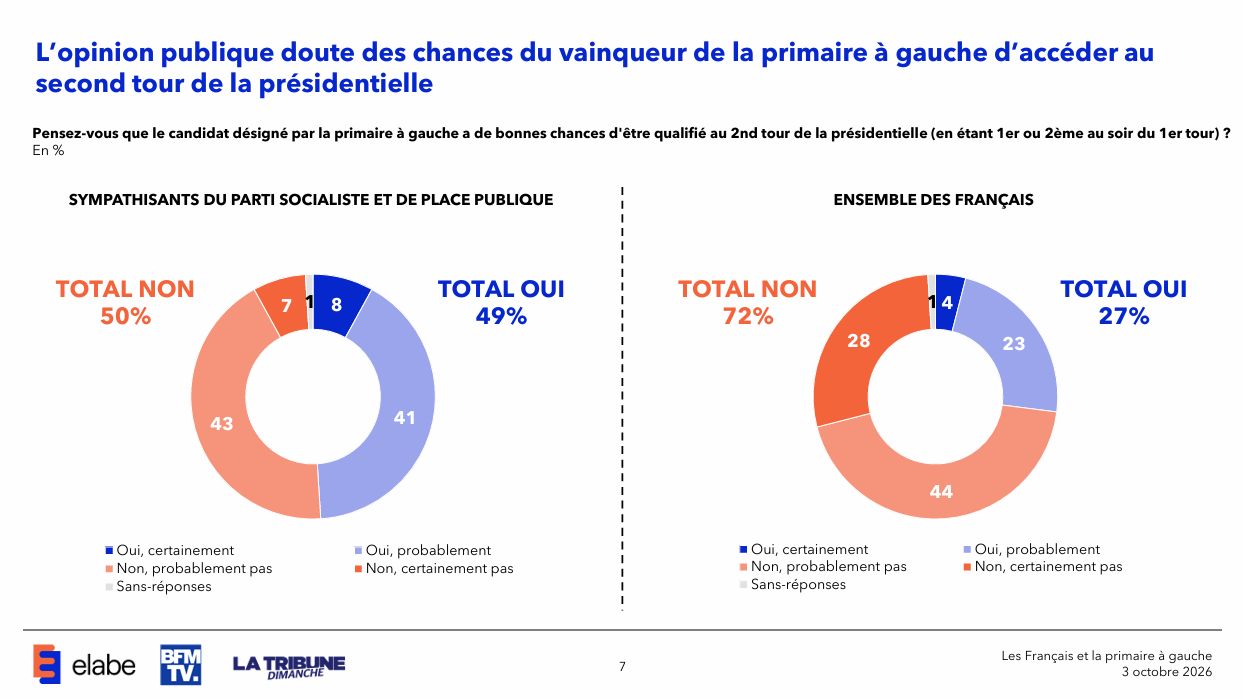
Inside the party, the mood is lukewarm. 56% of PS-PP sympathisants say they are interested, but only 11% say they are very interested, and they split 49% to 50% on whether their own nominee can reach the presidential run-off, with a mere 8% answering “certainly”. The wider electorate is blunter: 72% expect the winner to fall in the first round.
The programme is the easy part. Wage indexation and a windfall tax on oil majors both score 95% among PS-PP sympathisants, and cutting VAT on electricity to 5.5% wins 89% of the country, since nobody in polling history has lost votes promising cheaper electricity.
The fault lines show up when you put PS-PP voters beside LFI ones. Public debt ranks second among PS-PP priorities at 33%, ahead of climate, while only 9% of LFI sympathisants mention it. A return to retirement at 62 draws 95% of LFI sympathisants and a rather less militant 64% on the PS-PP side. Mass regularisation of undocumented workers scrapes 56% among PS-PP sympathisants and 40% nationally, which tells you why no front-runner is leading with it.
Then comes the question that has hung over every Socialist dinner since the NUPES was stitched together in 2022: 73% of PS-PP sympathisants oppose a legislative alliance with LFI, 44% of them strongly, while 92% of LFI sympathisants want one. Across the whole left, 60% are in favour. The candidates themselves, in this primary, disagree on the potential alliance, so the primary result will double as a referendum on Jean-Luc Mélenchon held without his voters.
PS-PP sympathisants are split 49% apiece on whether the exercise will unite or fracture the centre-left, and 67% of the public expect fracture. The Ecologists and Debout! are holding their own unitary primary on 11 October without the PS, with pro-Melenchon Marine Tondelier (EELV) and François Ruffin (former LFI) leading them.
When looking at age brackets, the interest in the primary peaks among 18- 24-year-olds (41%), who appear to be the most hopeful and are the most confident the nominee makes the run-off (48%) and the least hostile to LFI (48% favourable, against 13% of over-65s). The vote, however, is open only to members of the three organising parties or to those paying €10 or €15 online, an electorate that looks a good deal more like the retirees than the students.
The most revealing number sits deep in the cross-tabs: Renaissance sympathisants (38%) are more interested in this primaire than Ecologist ones (33%). Read alongside the rest, the poll describes a centre-left electorate whose instincts sit closer to the central bloc than to the Mélenchon-aligned far-left.
It’s clear that PS-PP sympathisants reject an LFI pact at almost exactly the national rate (73% against 74%), back parliamentary planning of immigration at 82% where LFI sympathisants manage 62%, and worry about debt like people who have read a Cour des comptes report.
With Emmanuel Macron unable to run, the nominee’s realistic route to the second round runs through the social-liberal wing of the Macronists, who want to continue their fight, rather than through Mélenchon’s voters.
Whether a members-only vote produces a candidate able to walk that route is what we will learn in the weeks to come but signs do point preliminarily to a more-likely-than-not Glucksmann victory, and a hard campaign after that.
👎Bardella falls into trap in antisemitism investigation
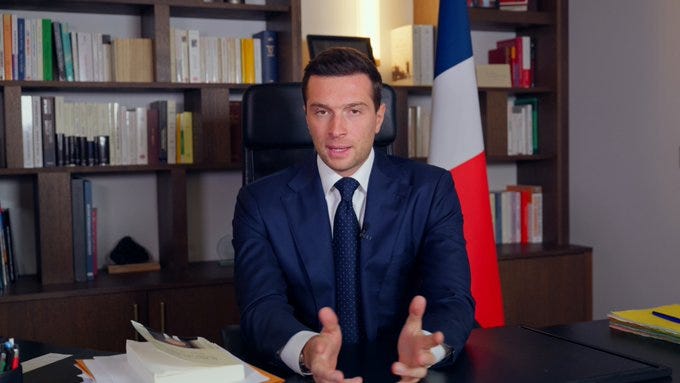
Moving on to the next story, which will undoubtedly shock many people: Mediapart has released proof of fairly severe antisemitism within the far-right Rassemblement National.
And it was Le Pen protegé Jordan Bardella!
On Monday 28 September, Mediapart published what it says are private conversations from 2013 in which a 17-year-old Jordan Bardella, then a Front National youth activist in Seine-Saint-Denis looking to move up the ranks, repeatedly recycled the oldest antisemitic tropes, from Jewish control of the banks to Zionism and high finance as a single conspiracy, alongside admiring words for the work of Alain Soral and Dieudonné.
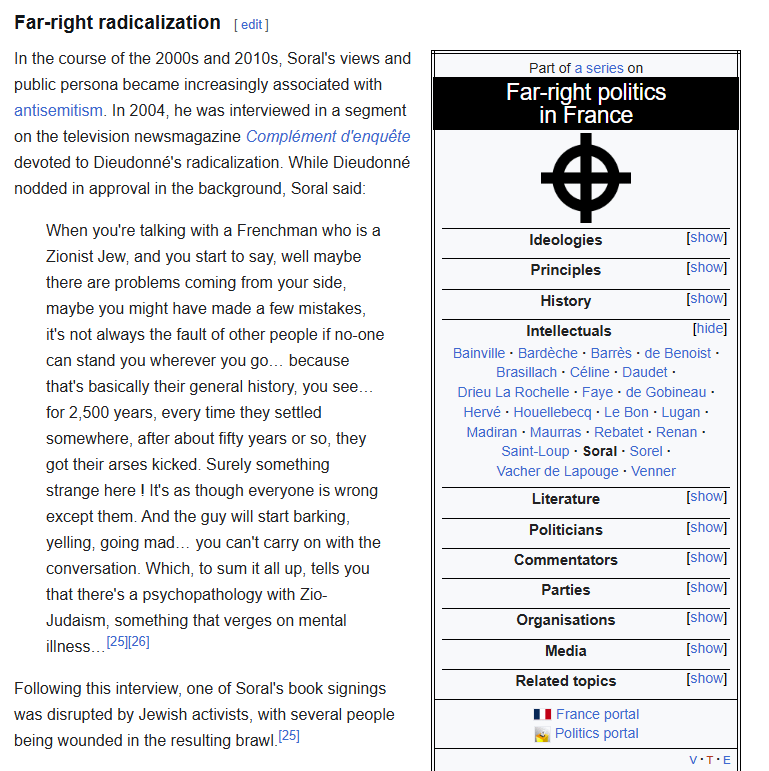
The president of a party that now bills itself as the “shield of the Jews” dismissed the material as crude forgeries and a dirty-tricks operation, while Marine Le Pen, ambushed by questions at a building trade fair, cut short her press conference and pronounced the story too mad to be anything but a fake, despite conceding that she did not actually know what it contained.
This was also accompanied by many, many claims that Bardella would never say anything antisemitic, that the RN was not antisemitic, that, in fact, it was the far-left who were the problem, not Bardella and co, and that all the claims were fake and Bardella would sue everyone for defamation because it was all fake.
Then, after several days of far-right defensive circus, Mediapart dropped its proof and work.
On Thursday, it explained that the Messenger conversations came from two completely unconnected sources who had the same conversations, and that one participant had obtained the full extraction from Meta under the GDPR before having it certified by a bailiff.
The export dates the exchange, showing it had not been altered afterwards, and clearly lists the account holder as Jordan Bardella, with biographical details scattered through it lining up well with anecdotes that Bardella himself had recounted in his 2024 autobiography. A further set of emails, one sent from an address traced to a 2012 FN Youth membership file, points to a sustained interest in Soral and his writings between 2012 and 2014.
Bardella’s answer was to call the evidence “crude montages” and add a forgery complaint to the defamation complaint that the Paris prosecutor has confirmed has been filed. Bardella has, funnily enough, chosen the ‘constitution de partie civile’ route for his complaint, which may be due to the fact that it has zero realistic chance of reaching a judgment before the 2027 presidential election and is therefore ideally suited to a campaign.
So, we have Bardella pretending forgery on one hand, and Marine Le Pen pretending she wasn’t convicted on the other, because her appeal means she doesn’t have to wear an electronic bracelet yet.
As mentioned earlier, the Rassemblement National took a hard line, and it held steady throughout the week, even as the ammunition used to defend Bardella grew increasingly strange.
Le Pen told her MPs that Mediapart had better “put on its Kevlar suit”, which many took as a very odd threat to the publication.
Frédéric Falcon, who drafts the RN’s housing programme, called Mediapart a “Nazi” site, which is odd for a party that was founded by literal nazis
Guillaume Bigot argued that the Mossad would surely have spotted any antisemitism before Israel welcomed Bardella on an official visit.
An anonymous RN deputy went even further than all of this, asking “who had never carved a swastika into a school desk with a compass” to throw the first stone, a line that defends the content of the messages and quietly abandons any pretence of forgery
Bardella’s own remarks on X after all of this fell in the same stream of thought, claiming that at 17 he was starting his life rather than doing politics
And these people want to run the French republic.
Thankfully, outside of the far-right bunker, everybody had a far more normal and less extremist position: Édouard Philippe judged it as “almost established” that Bardella had written the antisemitic messages, and Olivier Faure declared that Bardella could no longer aspire to reach Matignon and become Prime Minister.
President Emmanuel Macron, speaking from a state visit to Madrid on Wednesday, called the reported remarks "extremely serious and unacceptable" and took a swipe at Le Pen's Kevlar threat, prompting Bardella to retort that he had marched against antisemitism in Paris after 7 October 2023 while the President had stayed at home, a fair hit on November 2023 that does nothing to explain 2013.
However, outside the political class, the French appear less exercised: a YouGov poll found that 60% consider the remarks serious, yet only 38% think Bardella should step down as party president, while 47% say he should stay.
Those numbers explain why the RN is betting everything on denial, and also show where the real exposure lies.
Bardella’s value to Le Pen in 2027 has never been with her own voters, who forgive almost anything, but with the presentable Matignon candidate she needs to reassure the LR and centre-right voters she desperately needs to convert in a run-off to win the second round.
Unfortunately for her, Edouard Philippe’s intervention suggests that the central bloc intends to (thankfully) fight the RN aggressively on precisely that ground, using the affair to keep its voters from crossing over in the second round because, quite simply, it is so awful.
The day before Mediapart published, Bardella told L’Opinion that his appointment as Prime Minister was not a done deal; it was meant as modesty, and it may yet read as foresight.
🇪🇸Macron’s royal banquet ambushed by Senate
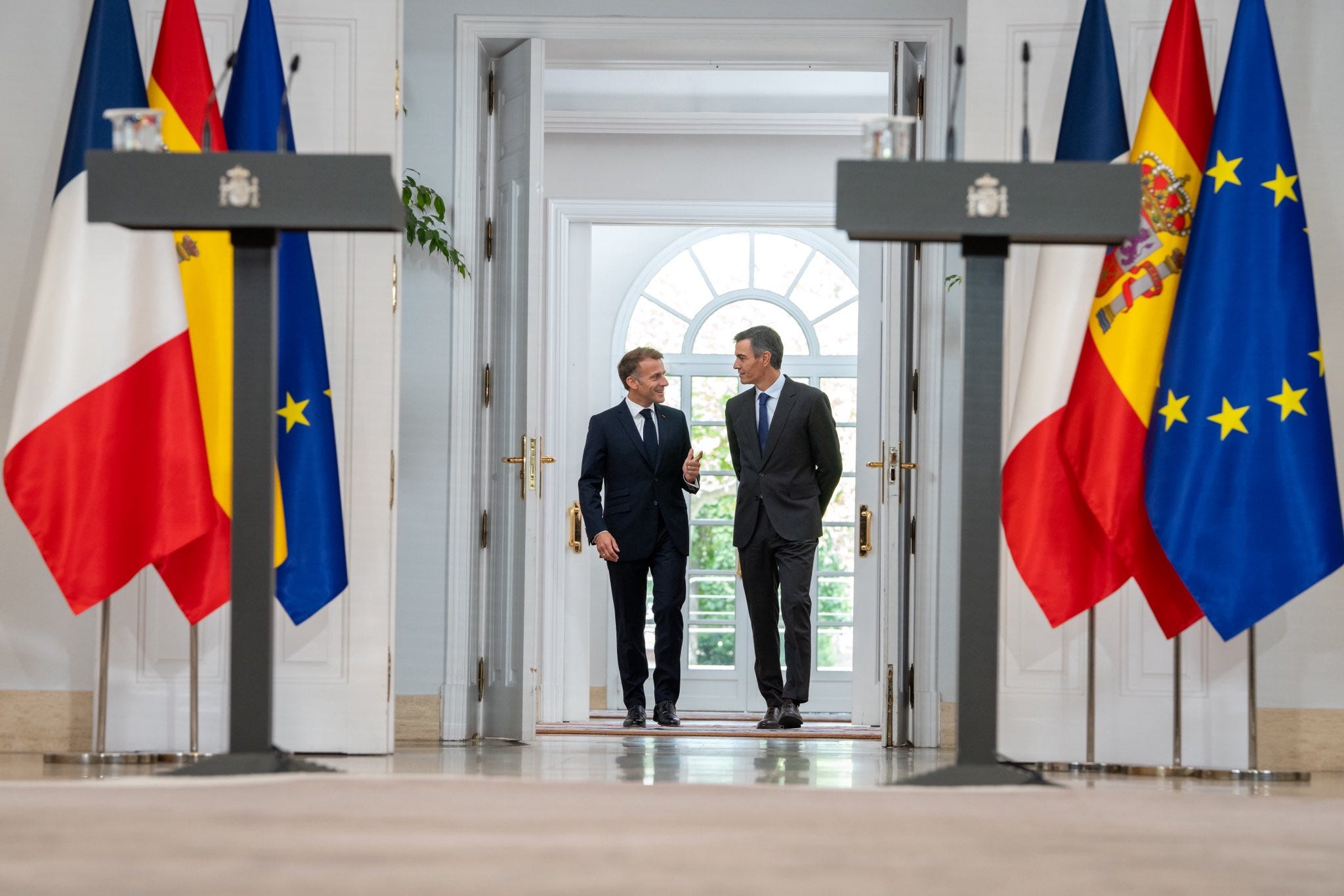
Moving back to more respectable politics: Emmanuel Macron had a two-day state visit to Spain this week, the first by a French president since Nicolas Sarkozy in 2009. While it was meant to crown three years of rapprochement with Pedro Sánchez, the initiative lasted only until they sat down to dinner.
This is because, as the Macrons were preparing for a gala dinner with Felipe VI and Letizia at the Royal Palace on Tuesday evening, the Spanish Senate rejected the Treaty of Barcelona by 142 votes to 106, with the Partido Popular (pp) and Vox voting down a friendship treaty that the two leaders signed in January 2023 and that the Congress of Deputies approved in June.
The Treaty of Barcelona
Signed by Emmanuel Macron and Pedro Sánchez at a bilateral summit in Barcelona on 19 January 2023, the Treaty of Friendship and Cooperation gives France and Spain a framework similar to the ones Paris already has with Germany (Élysée 1963, Aachen 2019) and Italy (Quirinal 2021).
It covers European, economic, energy, transport, education, cultural, health and security policies, and it is at its most concrete on the border, where it envisages shared public services in health, schooling and transport, alongside electricity interconnections, new rail and road links and the H2Med hydrogen corridor between Barcelona and Marseille. A separate defence cooperation treaty signed the same day is already in force.
Ratification in Madrid has been a slog from the start: the Congress of Deputies first refused to authorise the treaty in May 2025, when the PP and Vox opposition, combined with abstentions from Junts and Podemos, sank it, and only approved it on a second attempt this June.
The PP’s stated objection concerned article 2.4, which provides for a minister from one country to be invited regularly to the other’s Council of Ministers, a clause the party presented as a foreign intrusion into Spanish cabinet government even after Paris and Madrid clarified that the visiting minister would meet colleagues on the margins of the meeting.
The PP-controlled Senate referred the clause to the Constitutional Court, which unanimously found it compatible with the Constitution on 23 September, six days before the vote.
Having lost on the law, the PP did what they do best and fell back on petty politics, citing new reservations about bilateral consultations and the wording on energy interconnections amongst other things, with the evident aim of denying Sánchez a diplomatic trophy in the year before a general election, as they do everything they possibly can to take him down.
At the Moncloa on Wednesday, Sánchez told his guest that he “can only apologise” for the vote and promised that a friendship treaty would be approved before the end of the legislature. Macron preferred to play it down, calling the rejection “a setback, not a drama” and stressing that he respected the Senate’s decision.
The two governments at least confirmed a forthcoming agreement allowing Spanish companies to launch rockets from French Guiana, while Macron used the same press conference to condemn the antisemitic messages attributed to Jordan Bardella that we saw above, with the French campaign naturally following him across the Pyrenees.
Luckily, the treaty isn’t exactly dead, though the route back is narrower than Sánchez’s confidence suggests. Under article 74.2 of the Spanish constitution, a joint committee of deputies and senators must now seek a compromise, which the PP’s absolute majority in the Senate makes unlikely; if that fails, Congress can override the upper house with an absolute majority of 176.
In June the treaty scraped through the lower house with 175 votes, leaving Sánchez one deputy short on the same arithmetic, and Junts, which backed the text while complaining that it does too little for rail and road links between Catalonia and France, now knows precisely that it can start extracting payment.
Thank you for reading the French Dispatch! If you liked what you read, you should like this post and subscribe to the newsletter by clicking/tapping the button below:
And if you’d like to contribute a coffee or two to help fuel my coverage of the wild world of politics, feel free to click on the picture below:
