


👋Hey guys, Julien here. The French Dispatch is a reader-supported publication, and both our coverage of current affairs as well as our ability to bring you more news and information on the world around us is entirely funded by paid subscriptions and donations.
If you enjoy reading articles written by high-level experts, then make sure to support the publication by liking, subscribing, and sharing it with your friends and colleagues, and consider taking a paid subscription.

This week
📝Mélenchon unveils 2027 manifesto
🇪🇺Lagarde for President? Not likely.
📝Mélenchon unveils 2027 manifesto
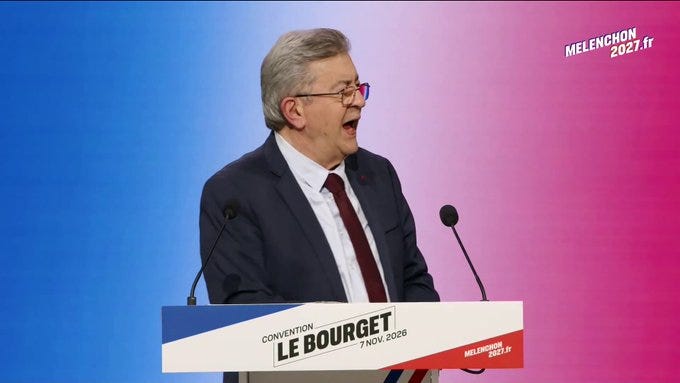
To start the week off: Jean-Luc Mélenchon’s fourth run at the Élysée has now seen its manifesto land with a splash at the fifth edition of L’Avenir en commun. The 212-page manifesto, containing 1,069 measures (238 of them new) is now on sale for a healthy €4.90 as of this Friday.
This was timed for LFI’s Le Bourget convention this Saturday, where 20,000 supporters came together for the candidate who is, on current projections, going to the run-off against far-right Marine Le Pen.
The far-left candidate’s message to the hall was clear: “We need to change everything”, and, to be entirely fair to far-left Mélenchon, is the most reasonable summary of his manifesto.
Anyone who sat through 2017 or 2022 will know the economic side of things: the SMIC (minimum wage) goes up to €1,700 net a month (roughly €1,480 today); Public sector pay goes up, housing benefit rises by 10%, and the prices of certain essentials are frozen.
The retirement age returns to 60, with a full pension after 40 years of contributions. The wealth tax returns, the Zucman tax on billionaires is added, income tax is split into 14 separate brackets, and inheritances are capped at €12 million. Companies would be held to a 1:20 pay ratio, and the working week would drift down towards 32 hours.
A significant chunk of this is the 1981 Programme commun with the dates changed, initially developed by François Mitterrand almost 50 years ago. In this, he set the French retirement age at 60, introduced the first wealth tax, and promised to make the rich pay. However, Mélenchon goes further than the former president by raising the tax floor and lowering the tax ceiling.
Capping what a boss can earn relative to the shop floor, or what a family can pass on at all, comes from a harder egalitarian tradition than what Mitterrand, the first left-wing president of the Fifth Republic, ever implemented.
While many of the economic policies happen to be old school, the packaging is new and green to reflect modern ecological principles and policies.
Mélenchon’s programme now leads with the climate: a gradual exit from nuclear power in a country that gets around two-thirds of its electricity from reactors, 100% renewable electricity by 2060, a ban on night flights between 11pm and 6am and a compulsory nine-month ecological national service paid at the SMIC.
A few pages on, it suspends the low-emission zones (ZFE) that keep the dirtiest cars out of city centres, a cause the RN has been pushing for some time, giving many the idea that an ecologie populaire, as it turns out, ends at the périphérique.
It also shows a key lack of hindsight through the nuclear policy, where Germany has found itself increasingly reliant on coal after shutting down its nuclear energy production facilities, which is almost guaranteed to occur in France too.
The rest of the book offers a Sixth Republic with more power for citizens, the end of the Article 49.3 power, a tougher line on discrimination in the police and recognition of the 17 October 1961 massacre as a state crime.
Abroad, and highly concerning, is that Mélenchon would renegotiate the EU treaties and, in the meantime, stop applying the rules he dislikes, showing a disinterest in how this idea panned out for David Cameron pre-Brexit. He also announced he would gradually take France out of NATO’s integrated command, undoing Sarkozy’s 2009 return and severely hamstringing European defence structures at a time when Russia is sharpening the knife.
Naturally, support for a Palestinian state alongside Israel is in there as well, but surprisingly with much less prevalence than during the 2024 European Elections. Though, since France recognised Palestine last year, this policy no longer sets him apart from anyone aside from the far-right.
However, one major issue remains: there is no price tag or budget for the programme.
The LFI manifesto was published without detailed costings, and while LFI says around fifty supporting documents will follow after Éric Coquerel presented a “revised budget” for 2027 in October, none of this will reflect the true cost for the government or citizens.
Budgets have brought down more than one government since 2024, so the costings will get more scrutiny than the promises, LFI knows it, and so it’s keeping numbers away from the discussion.
The timing also shows who the book is really aimed at. Publishing the manifesto first, in this much detail and with ecology front and centre, sets the terms for every left-unity conversation on the horizon, and will add to the evidence that left-wing candidate Raphaël Glucksmann and his programme are not actually left-wing.
The écologistes and communistes, who gave LFI’s alliance offer a cold reception in April, will now also expect to be asked which of the 1,069 they object to and why they’re not supporting their own policies.
And of course, everyone to the right of Europe Ecologie Les Verts will be targeted with political harpoons.
Mélenchon’s 2027 Programme
Purchasing power
Raise the SMIC to €1,700 net a month (+€220)
Raise civil servants’ pay
Increase housing benefit (APL) by 10% to help with rent
Freeze the prices of certain essential goods to prevent excessive increases
Pensions
Retirement at 60 instead of 64
Full pension after 40 years of contributions
Tax
Restore the wealth tax (ISF) on large fortunes
Introduce the Zucman tax to raise taxation on billionaires
Create 14 income tax brackets so the wealthiest pay more
Cap inheritances at €12 million
Ecology
Gradually phase out nuclear power
Ban night flights between 11pm and 6am
Introduce a compulsory nine-month ecological service, paid at the SMIC
Produce 100% of electricity from renewables by 2060
Suspend low-emission zones (ZFE), which restrict the most polluting vehicles in some cities
Work
Move gradually to a 32-hour week
Limit pay gaps within a company to 1:20
Make state aid to companies conditional on social and environmental commitments
Health
Seven days’ leave on the death of a friend
Up to three days of self-certified sick leave without seeing a doctor
100% reimbursement of healthcare by the Sécurité sociale
Reimburse psychotherapy sessions for under-26s
Youth
An allowance guaranteeing young people a minimum income
€1 meals for students
A paid ecological service at the SMIC for under-25s
Society
Step up the fight against discrimination, particularly in the police
Recognise the massacre of Algerians on 17 October 1961 as a state crime
Politics
Replace the Fifth Republic with a Sixth Republic giving citizens more power
Abolish the 49.3 so governments cannot pass legislation without a vote
Europe and international
Renegotiate the EU treaties and refuse to apply EU rules deemed incompatible with the programme
Gradually withdraw from NATO’s integrated military command
Support the creation of a Palestinian state alongside Israel
If you’d like a more in-depth analysis of the programme, comment below and we can talk about where these ideas initially all came from, and whether some of these have already been put in place by a socialist, liberal, or conservative government in the past.
Oh, and remember to subscribe.
🇪🇺Lagarde for President? Not likely.
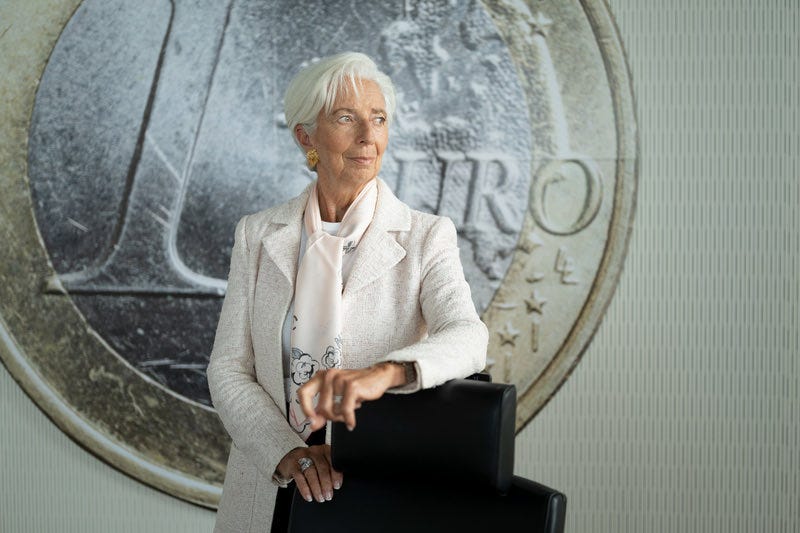
The bloc central’s quest for its saviour from political oblivion has now reached Frankfurt, and it’s probably going to head back to Paris completely empty-handed.
Just last week, Christine Lagarde announced she would leave the ECB on 7 February, nine months before the end of her ECB term, and her entourage made known that it was in no small part because she wanted to speak freely on French and international politics again.
Which was, unsurprisingly, enough to get the right and the centre quietly wondering whether Sarkozy’s former finance minister might be the candidate they have failed to produce for a post-Macron political field.
This also means that she joins a list of imagined recruits that already includes Jean Castex, Jean-Louis Borloo, François Baroin and Sébastien Lecornu, none of whom have shown any interest in running a suicidal presidential campaign, or the polling numbers to show any real chance of victory against the far-right or far-left
The case for a Lagarde unity candidacy rests mainly on everyone else’s numbers.
Gabriel Attal, Édouard Philippe and Bruno Retailleau are all sliding, and none of them makes the second round in the latest polls, and Lagarde’s popularity numbers don’t look much better.
To make matters worse for everybody, Lagarde told La Croix on 30 September that running at 70 would be “not at all a good idea,” and seemed keen to put the idea back into Pandora’s box.
However, since these initial moves away from the idea, Lagarde has done nothing to calm things down. Her farewell remarks in Frankfurt about truth being bent by misleading representations of reality could have come straight from Macron’s camp de la raison, and back in July she told Les Échos she might leave early so that a European voice could be heard in the presidential debate.
In public, the declared candidates are falling over themselves to be very nice about her. Gabriel Attal (Renaissance), who now really really wants a primary for the centre, praised her values on TF1. Four days later on the same channel, Edouard Philippe (Horizons), who really really doesn’t want a primary because he still thinks he’s polling at 18% instead of the actual 8%, called her formidable and left it there, because he wants the fiscal-rectitude lane to himself.
It doesn’t help that, not too long ago, Lagarde came close to running against him for the Le Havre town hall.
Bruno Le Maire, from his side, said he was enthusiastic, which says more about his own hopes of being called upon than hers, and it was also nice to hear from the former finance minister after his disappearance from French political life.
Off the record, almost nobody expects it, including yours truly. Lagarde’s name came up at the MoDem’s group meeting on 3 November and apparently drew fewer sneers than Thierry Breton did when Bayrou floated him before the summer.
Laurent Wauquiez, the man who declared his presidency candidacy back in 2023 (not joking) had lunch with her over the summer and came away convinced she wasn’t thinking about the presidency.
Macron reportedly believes she’s aiming for Davos and the World Economic Forum, and that fits what Reuters has been reporting: the WEF could name her chair within weeks, although the FT has heard that American members are less keen.
The date itself is less mysterious than the speculation suggests. Leaving in February lets current EU leaders, including Macron, choose her successor before a spring election that could hand the Élysée to the far-right RN. It also leaves her 33 days before sponsorships close.
Even on the generous reading, the practicalities are brutal. ECB neutrality keeps her silent until February, leaving only a month to find 500 mayors, and nobody can see a team. Her one outing so far, at Hervé Morin’s apple fair in Normandy, produced a speech so technical it disappointed the crowd and cooled any interest.
A Renaissance MP summed up the problem: “Can you imagine her campaigning in the Lot?” Retailleau’s camp says nobody on the ground has mentioned her once.
That is the bloc central’s real difficulty, and Lagarde makes it plain. The camp keeps looking for a better CV when what it lacks is voters outside the big cities. Le Pen would design the opponent as a Frankfurt-trained, pearl-wearing pro-European technocrat that doesn’t understand the common people, if given the slightest opportuinity.
A Lagarde free to speak may still matter more as a witness than as a candidate, weighing in on the RN’s plans for the euro and the ECB at a moment when the bloc central has no one else the markets will listen to.
The one candidacy insiders take seriously is a Monti-style lifeboat run in a financial crisis, with a far from encouraging precedent. Monti was parachuted into the Palazzo Chigi in 2011 without facing voters, and when he finally stood in 2013, his Scelta Civica took 8.3% in that election.
Because, surprise surprise, technocrats get appointed when politics breaks down, and then rarely survive the election that follows.
Thank you for reading the French Dispatch! If you liked what you read, you should like this post and subscribe to the newsletter by clicking/tapping the button below:
And if you’d like to contribute a coffee or two to help fuel my coverage of the wild world of politics, feel free to click on the picture below:

Good luck to France!!! Your political options seem pretty suboptimal. Thanks for sharing this - your reporting is excellent.