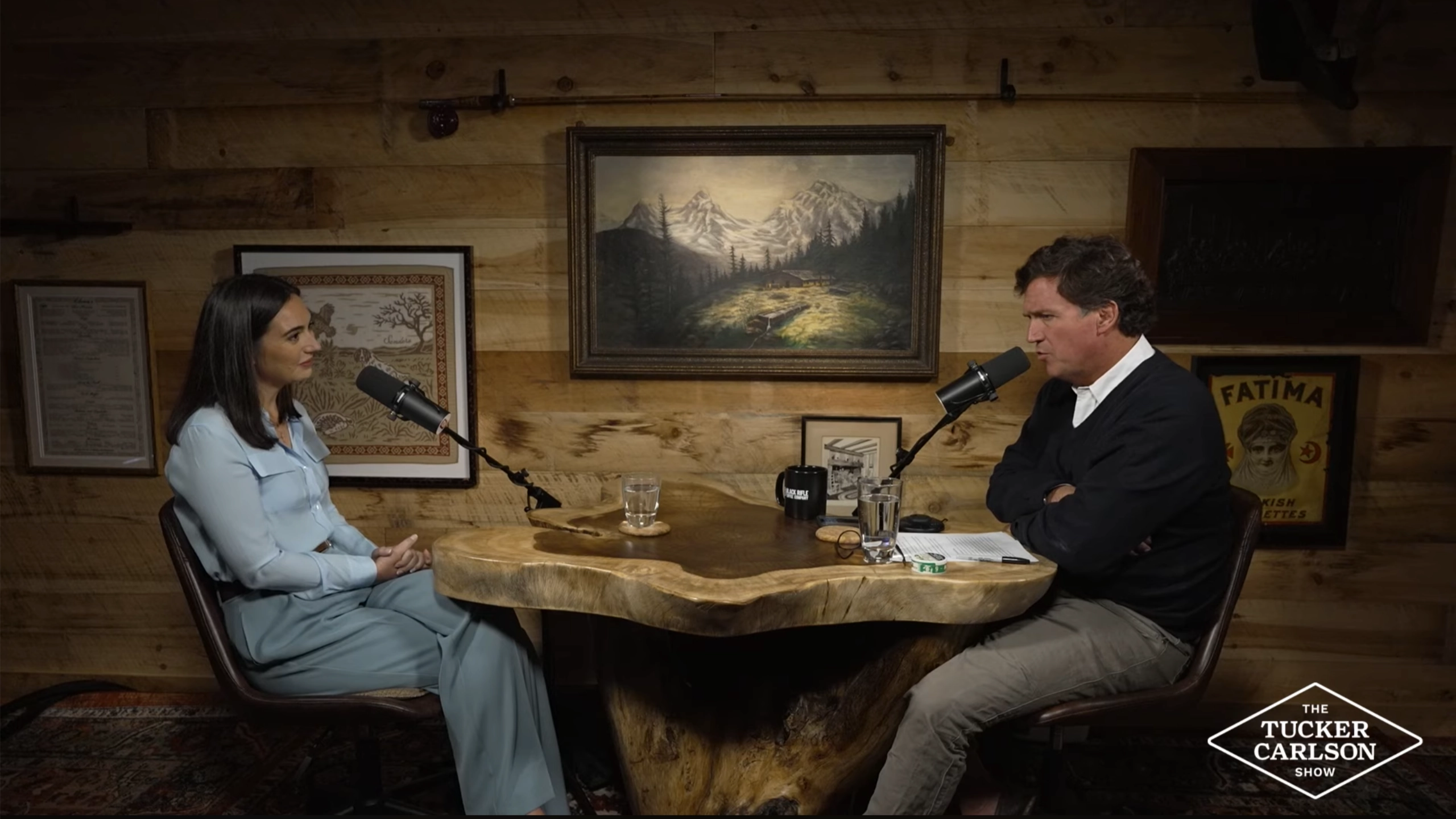
Yuliia Mendel and the Anatomy of a Disinformation Campaign
How Zelenskyy's former spokesperson became a vector for Russian disinformation, and why Tucker Carlson's platform was the point.

👋Hey guys, Julien here. The French Dispatch is a reader-supported publication, and both our coverage of current affairs as well as our ability to bring you more news and information on the world around us is entirely funded by paid subscriptions and donations.
If you enjoy reading articles written by high-level experts, then make sure to support the publication by liking, subscribing, and sharing it with your friends and colleagues, and consider taking a paid subscription.
The recent interview between Yuliia Mendel and Tucker Carlson was not merely a media appearance; it functioned as a calculated effort to erode international support for Ukraine at a pivotal moment.
When President Volodymyr Zelenskyy’s former press secretary sat down with the American conservative podcaster on May 11, 2026, the conversation was framed as a bombshell revelation. In reality, it appears to be a masterclass in intertextual messaging. Mendel, who once described Zelenskyy as a “breath of fresh air” and a “meritocrat by nature” in her 2022 memoir, suddenly shifted to labelling him a “dictator” and the “greatest obstacle to peace”.
The dramatic reversal can be understood as more than just an isolated incident of a disgruntled former employee speaking out; however, it fits into a broader information campaign that undermines the foundations of Ukraine’s defence.
Carlson’s platform is a deliberate choice. His audience, averaging 3.2 million viewers in prime time and over 5.5 million YouTube subscribers1 2, has long been fed a steady diet of simplified narratives claiming Ukraine is “to blame” or that Zelenskyy is an “obstacle to peace.”
It’s important to remember that Carlson has a well-documented history of amplifying Kremlin-aligned talking points, having told his viewers that Russia is “not the enemy” of the United States and famously interviewing Russian President Vladimir Putin in 2024 without challenging him on war crimes3.
By utilising Carlson’s expansive reach, the interview served as a strategic hit aimed far beyond the President himself. It targeted the provision of Western weaponry essential for Ukrainian defences, the stability of sanctions against the Russian Federation, and the fundamental right of Ukraine to conclude this war on its own terms.
The Anatomy of a Smear Campaign
During the interview, Mendel advanced a series of claims that closely echoed established Russian disinformation tropes. She suggested that Zelenskyy’s alleged drug use is an “open secret”, a baseless rumour long pushed by Russian state media and repeatedly debunked by independent fact-checkers.
This is not a casual accusation, but a very specific action that is designed to play into the Kremlin’s favoured trope of portraying the Ukrainian leader as an unstable, drug-addicted and paranoid narcissist unfit to command Western support or negotiate peace.
Similarly, Mendel weaponised the very real internal challenges Ukraine faces. It is true that Ukraine is actively grappling with corruption, as evidenced by recent high-profile legal developments, including the May 2026 arrest of former top presidential aide Andriy Yermak on money laundering charges.
However, rather than acknowledging these investigations as evidence of functioning democratic accountability and anti-corruption reforms in wartime, Mendel uses them to portray a state beyond redemption. She claimed that Ukraine suffers from a total lack of free speech, a narrative contradicted by the 2026 Reporters Without Borders Press Freedom Index, which ranks Ukraine 55th globally, higher than several Western democracies and vastly outperforming Russia’s dismal 172nd placement.
Perhaps most egregiously, Mendel asserted that Zelenskyy personally agreed to cede the Donbas region to Russia during the 2022 Istanbul negotiations. The Ukrainian Presidential Office swiftly refuted this, noting that Mendel, who left her post in 2021, had no access to state decision-making or the negotiation process.
Yet, the truth of her statements is almost secondary to their intended effect. As disinformation researcher Alyona Hurkivska noted, Mendel’s portrayal depicts Ukraine as a “weak, zero-agency, corrupt, and hopeless country with no future”.
It is also worth recalling that Mendel resigned in 2021 following complaints of aggressive behaviour towards journalists, and that just a year later, she published a memoir about Volodymyr Zelenskyy (‘The Fight of Our Lives: My Time with Zelenskyy, Ukraine’s Battle for Democracy, and What It Means for the World’) describing him as the “nation’s protector”. This adds further questions regarding her aggressive about-face.
This framing attempts to rob Ukrainians of their voice, suggesting they are mere victims of their own leadership rather than active defenders of their sovereignty. It mirrors the Kremlin’s cognitive warfare strategy, which seeks to undermine Western resolve by portraying the defence of Ukraine as a lost cause.
It is no coincidence that within 24 hours of the interview’s release, Russian state media apparatuses, including RT and prominent propagandists like Vladimir Soloviev and Olga Skabeeva, were eagerly amplifying Mendel’s claims, according to NewsGuard’s monitoring.
After decades of experience with Russian information warfare, Ukrainians have long developed an ear for such dissonance, and their warnings have increasingly found institutional backing in the West. The mechanism behind such campaigns has already been exposed in court.
In 2024, the U.S. Department of Justice indicted two RT employees over a $10 million scheme that covertly funded right-wing American content creators through a company called Tenet Media, whose stable of influencers included prominent conservative commentators, to spread these types of narratives precisely.
But more can and has to be done.
Targeting the Lifelines of Defence
The timing of the Mendel broadcast is critical. Ukraine is currently navigating a complex geopolitical landscape where international support is both vital and vulnerable. In the United States, debates over munitions stockpiles and the viability of continued military aid remain contentious 4. Meanwhile, the European Union recently finalised a €90 billion loan to support Ukraine’s urgent budgetary and defence needs.
By painting Ukraine’s leadership as hopelessly corrupt and dictatorial, the Mendel-Carlson interview provides rhetorical ammunition to those seeking to cut off this essential aid. If Western audiences can be convinced that their tax dollars are funding an authoritarian regime rather than a democratic ally fighting for survival, the political will to sustain military assistance will inevitably fracture.
Furthermore, this narrative threatens the stability of sanctions against the Russian Federation. As Transatlantic unity faces ongoing pressure and the global energy market fluctuates, enforcing sanctions requires unwavering commitment. Messaging that delegitimises Ukraine’s struggle serves to justify sanctions evasion and the normalisation of relations with Moscow.
The Reality of the Ukrainian Struggle
Former officials are, of course, entitled to criticise wartime leadership, and democracies depend on dissent and scrutiny of our political leaders. A problem arises, however, when unverified claims are amplified through media ecosystems that have repeatedly circulated Kremlin-aligned narratives, exploiting democratic growing pains to justify external abandonment.
The reality of the Ukrainian struggle is found in the daily grind of defence and recovery, not in the polished frames of a manipulated broadcast. While such “bold interviews” attempt to package falsehoods as alternative perspectives, the true measure of the state lies in its endurance and the agency of its people.
Consider the rapid decision-making immediately following Russian strikes. Just hours after a recent 72-hour truce expired, Russia launched over 200 attack drones at Ukrainian targets. In the face of such relentless aggression, Ukrainian communities continue to demonstrate extraordinary fortitude. The World Bank estimates the cost of Ukraine’s reconstruction at nearly $588 billion, yet local initiatives focused on energy security and business development in frontline cities persist 5.
This is the tireless fight for every international aid package and the unwavering support for local communities on the front lines. It is a reality defined by the 58% of Ukrainians who continue to express trust in their President amidst an exhausting war, not by the fabricated grievances of a former aide seeking relevance on a foreign stage.
The Mendel-Carlson interview does not exist in a vacuum. It appears to be the latest iteration of this strategy. It relies on the illusion of insider credibility to launder Kremlin-aligned messaging for a Western audience.
The international response to Ukraine should be guided by verifiable evidence and strategic realities rather than narratives amplified through disinformation ecosystems. As the global community evaluates its ongoing commitment to Ukraine, it must base its decisions on the documented realities of the conflict, rather than the orchestrated theatre of political manipulation.
Thank you for reading the French Dispatch! If you liked what you read, you should like this post and subscribe to the newsletter by clicking/tapping the button below:
And if you’d like to contribute a coffee or two to help fuel my coverage of the wild world of politics, feel free to click on the picture below:
PR Newswire. “Tucker Carlson Network Sees Historic Growth.” Morningstar, April 30, 2026.
HypeAuditor. “Tucker Carlson YouTube Stats.” May 2026.
The Washington Post. “Allies question Trump’s Ukraine weapons plan as Iran war depletes US supplies.” May 11, 2026.
Association of Frontline Cities and Communities. “Energy resilience, support for people, business development priorities for 2026.” February 6, 2026.


