


👋Hey guys, Julien here. The French Dispatch is a reader-supported publication, and both our coverage of current affairs as well as our ability to bring you more news and information on the world around us is entirely funded by paid subscriptions and donations.
If you enjoy reading articles written by high-level experts, then make sure to support the publication by liking, subscribing, and sharing it with your friends and colleagues, and consider taking a paid subscription.

This week
🗳️Philippe Brun is out of the primaire, calendar continues
🤔Far-Right Dupont-Aignan announced candidacy, Zemmour accidentally does the same
🇷🇺Macron gathers candidates as Russia escalates
EU Influencer rankings are out!


So, to kick this article off on a good note: I was once again nominated as an influencer on and in the EU!
It’s always a pleasure to be recognised as an influential voice in and on the EU by ZN in their annual #EUInfluencer rankings, and I'm looking forward to continuing to have a positive impact across my work.
🗳️Philippe Brun is out of the primaire, calendar continues
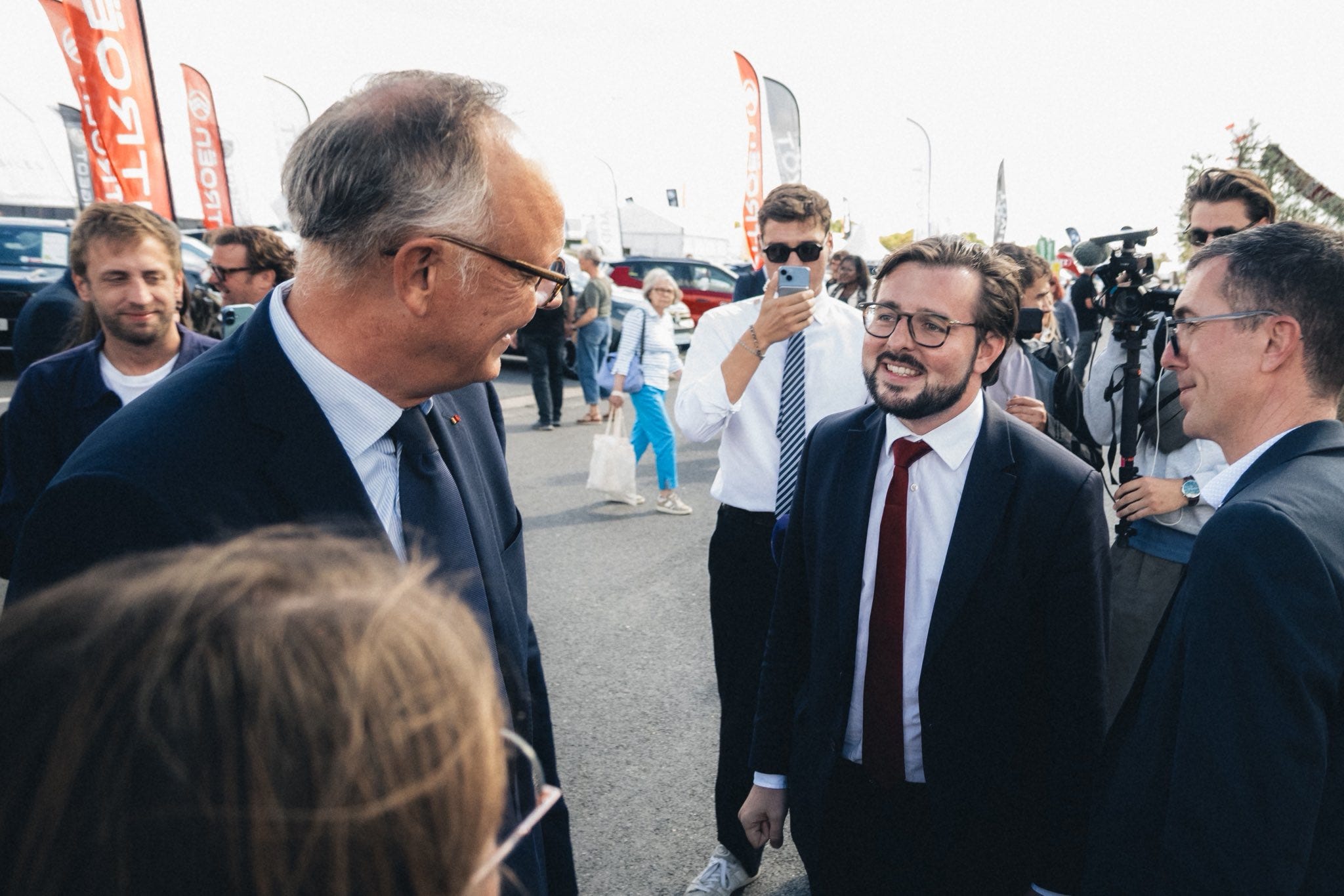
Six candidates said they had filed for the Socialist primaire by Tuesday’s deadline. Five made it onto the ballot: Olivier Faure, Jérôme Guedj and Ségolène Royal for the PS, Raphaël Glucksmann for Place publique, and Emmanuel Maurel for the Gauche républicaine et socialiste.
Fabien Verdier, the former mayor of Châteaudun, fell short on sponsorships, which the PS sets at either 10 parliamentarians or 50 mayors across three regions. The sixth, Eure deputy Philippe Brun, says he had all his signatures, but the party removed him for a different reason.
The party national bureau met on the morning of Wednesday 16 September to validate the candidacies and, in the case of Brun, suspended him as a precaution due to reports made to the party leadership of “facts that could amount to a criminal offence”, which Le Monde linked to Brun’s former parliamentary collaborator.
The PS later told AFP that the allegations cover harassment, physical violence and family employment, despite deputies being banned from employing a relative or spouse. The Socialist group in the Assemblée Nationale then met and expelled him under its statutes, while stressing that the party did not intend to substitute itself for the competent judicial bodies and courts, a line that sits awkwardly beside a suspension that landed within hours of the report arriving.
Brun’s statement on the topic was short: he claims his former assistant was dismissed for gross misconduct, that he does not know the facts of what she has claimed, and that no party committee heard from him before it acted on a message sent at 23:50 the night before their decision. Brun’s lawyers date the dismissal to June 2026 and have criticised the process as rushed and not following proper procedure, with no criminal complaint filed against him.
Brun’s team, however, plan to file a criminal complaint of their own for false accusations against him, and on Saturday he asked PS First Secretary Olivier Faure to put him back in the race. Nothing here has yet been tested by a court or a party commission.
It’s also important to note that Brun has basically not featured in any polls, and is extremely unlikely to become the Presidential candidate for the PS.
Guedj, who had hoped to face Brun for the very obvious reason just stated, appeared on Radio J this Sunday where he called the decision “extremely violent”, taken without Brun being informed, and said the leadership was “too quick off the mark” with their decision.
Guedj then immediately argued the opposite: that the bodies concerned had shown “culpable delay”, pointing to press reports of alerts going back to early summer. He compared the case to that of Julien Bayou, the former EELV national secretary accused of psychological violence who was eventually cleared by the courts.
Guedj is, therefore, asking for a party that acts not only faster, but en même temps also acts with more caution, and the PS now stands accused of both haste and delay while onlookers remain baffled by this line of argumentation.
Now there is a bigger issue here: if something reached a party body in July this year and just sat there, there is a different story about a leadership that waited almost three months before reacting to a fairly problematic report about potential harassment and physical violence by one of their own.
Unfortunately for Brun, the calendar will settle more than just his argument: the first round of voting will take place on Friday 9 and Saturday 10 October and the second on Friday 16 and Saturday 17 October.
The three televised debates for the candidates in the PS primaire are also slotted in for Wednesday 23 September (LCI), Thursday 1 October (France 2) and Sunday 4 October (BFM-TV).
And unless a party body or a court acts quickly, Brun will remain outside of this left-wing primaire and will fail to fail to become the Parti Socialiste’s Presidential candidate.
🤔Far-Right Dupont-Aignan announced candidacy, Zemmour accidentally does the same
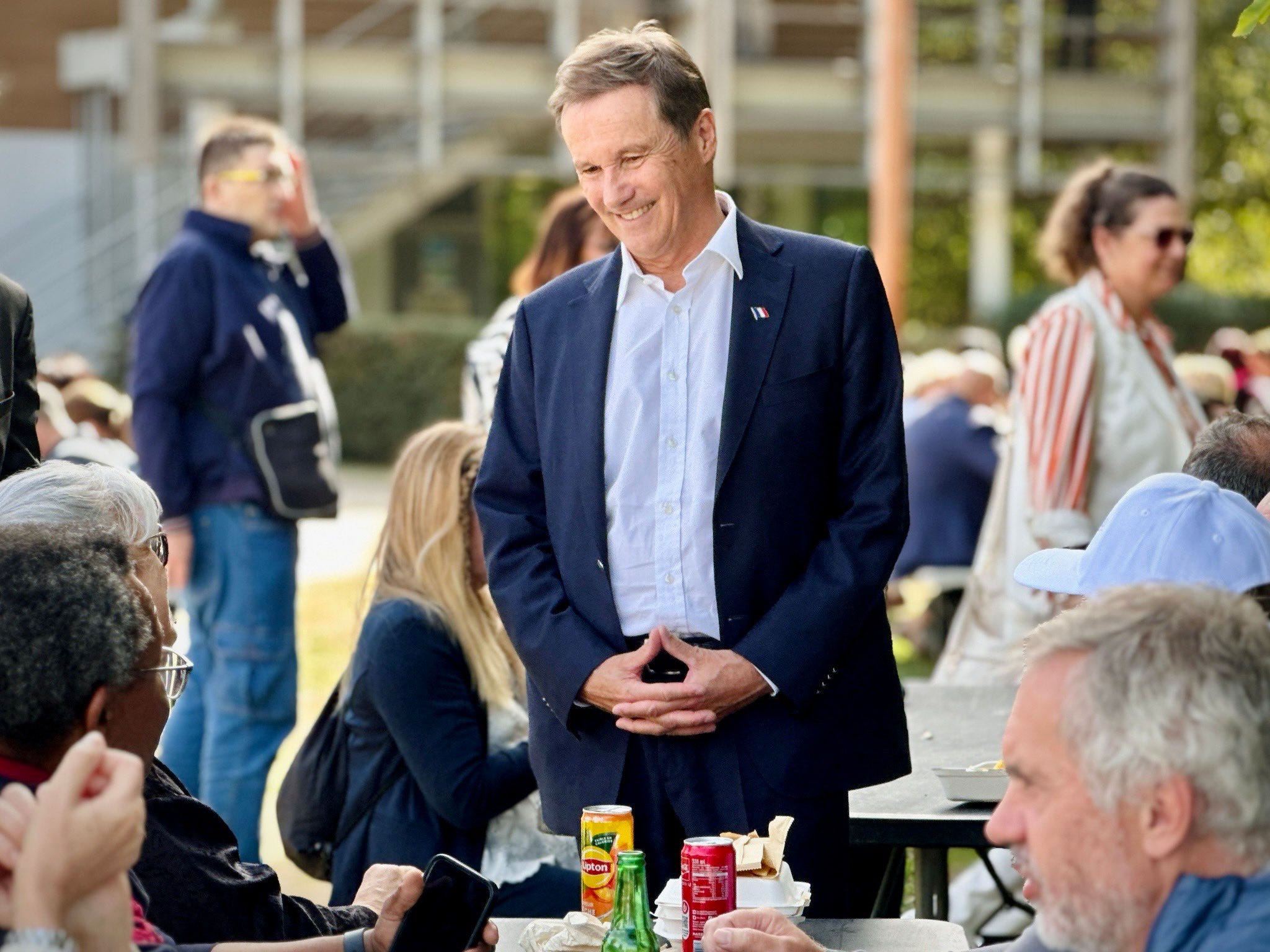
So, sticking with potential candidates: far-right Nicolas Dupont-Aignan has announced that he is going to be candidate yet again for the Presidency. Previously, he was tapped by Marine Le Pen as a potential Prime Minister in 2017, and he has been seen publicly supporting both Donald Trump and Jair Bolsonaro.
On top of that, Eric Zemmour, known for his striking resemblance to Gargamel from the hit Belgian comic The Smurfs, also accidentally announced his own candidacy live on TV before walking it back.
Behaving rather cagily when speaking on BFM TV, Zemmour was asked about his career as a politician, leading to the following exchange:
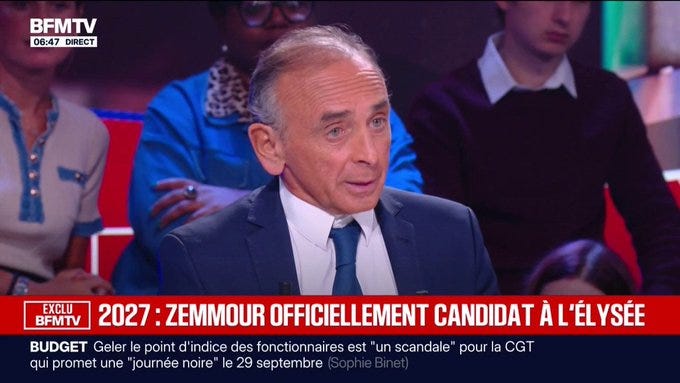
Zemmour: “But I’m not a politician; I’m a candidate for the Presidency of the Republic”
Journalist: “So, is this an announcement tonight, then?”
Zemmour: “No, but you know what I mean.”
Journalist: “You’re standing as a presidential candidate tonight, Éric Zemmour.”
Zemmour “You know what I mean, I’ll be standing as a presidential candidate.”
And as Philippe Moreau Chevrolet put it: this is the first time in the history of the 5th Republic that a politician accidentally announced his presidential campaign.
But how well are we expecting both of these far-right politicians to perform in the upcoming election? Well, we can look at their past results for an indication:
Ah….well.
🇷🇺Macron gathers candidates as Russia escalates
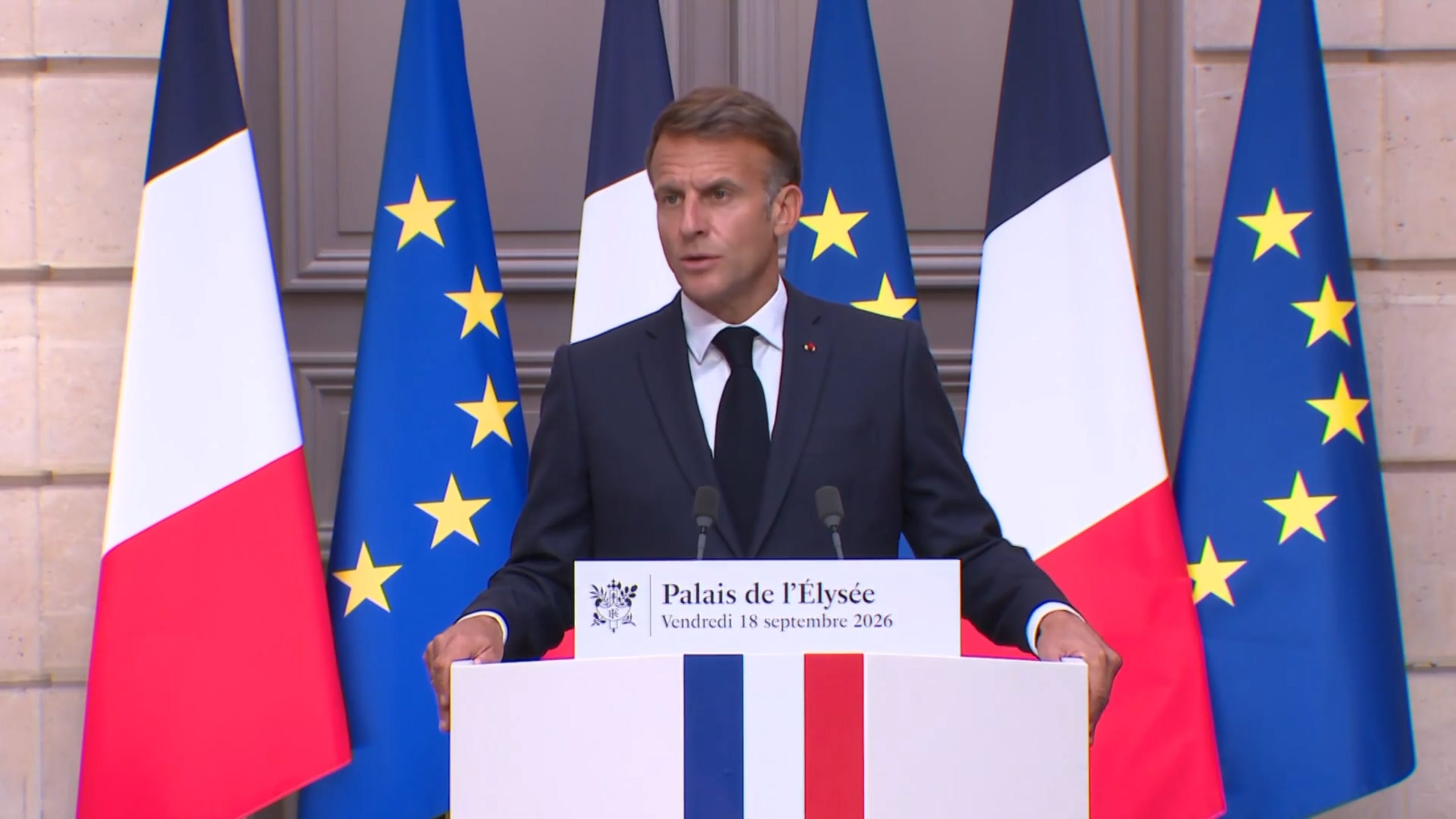
Seven months before the presidential election, Emmanuel Macron invited the political forces represented in the Assemblée nationale and the Sénat, and their candidates, to the Élysée on Friday 18 September. The heads of France’s security services, military intelligence and defence secretariat, plus the Director General of Energy, briefed the room on the two crises Macron says are shaking the country: Russia and energy prices.
You can read the translated transcript of his press conference after the meeting here:
Macron: “The Day We Are Physically Attacked, We Will Not Be Warned”

Full English text of Macron's 18 September 2026 press conference on Russia's hybrid threat, Donald Trump’s Hormuz crisis, and energy prices.
On Russia, Macron said the hybrid threat has “intensified” in recent weeks. His examples were a drone attack on a passenger train from Kyiv, the attempted attack on Leipzig airport, a flare fired close to a Danish frigate and airspace incursions across Europe. German services attribute Leipzig to the GRU, he said, and it failed only because the device did not work, when “the consequences would have been tragic”.
Contacts with Russia stay at the level of the services, and the recent attacks came with no warning: before a physical attack, “we will not be warned”. Asked about future talks with Putin, he offered nothing beyond that services channel. The response will not be announced in advance, but it “will not go unanswered”, which is the strategic ambiguity he reached back to from February 2024, now applied to retaliation.
At the request of Macron and the Prime Minister, the Interior Minister convened all the zonal prefects on Thursday and asked the government to prepare a protection plan for critical infrastructure, and the most sensitive defence-industrial sites, to defend against potential drone and cyber attacks. The operative word is “prepare”: the transcript gives no deadline, budget or list of sites. He also held up Sweden’s “total defence” principle as consistent with France’s resilience strategy, which turned the security briefing into a message to the public.
On energy, Macron blamed the war on Iran and the closure of the Strait of Hormuz, which he said remains “almost blocked”, along with Houthi attacks that have cut volumes through the Saudi pipeline to Yanbu on the Red Sea. France, he stressed, neither chose nor joined that war.
Macron’s answer, ultimately, remains diplomatic and logistical: a tanker escort mission, assembled with the International Maritime Organization since April, that is ready to be launched once a deal is found between Trump and the Iranian government; There are agreements signed with Iraq and talks with Saudi Arabia, Qatar, the UAE and Nigeria; a meeting with Canada’s Mark Carney on Sunday about petroleum and LNG; a G7 energy meeting “in the coming weeks”; and a referral to the Commission President on gas storage, refining flexibilities and biofuel.
The French President isn’t resting on his laurels.
The arithmetic is awkward, however. Macron has been clear that an Iran-US agreement is “unlikely in the short term” and admits France does not hold “the key to Hormuz” or any solutions for the ongoing war. Yet, despite this geopolitical reality, President Macron has promised results on prices in the coming weeks and months.
Which is only possible if bypass routes carry the load, and the Saudi route to Yanbu is the one we have reason to suspect the Iran-backed Houthis have hit recently, and which was temporarily shut after a drone attack on 12 September.
A journalist put the average price of diesel at €2.39 a litre and asked whether €2.50 or €3 was coming by year end, and Macron gave no figure. “Everything must be analysed and tried out”, he said, before turning on those demanding price freezes and more spending, the same people who 15 days ago said he had done far too much, irresponsibly, between 2022 and 2024. While he named nobody, so that none of the candidates were directly targeted, it was clear that he was referencing the political positions of La France Insoumise, as well as Marine Le Pen, Jordan Bardella, and the rest of the far-right.
It was time to be “consistent and honest with the French”, Macron said, and to remember that “the French people’s money” comes back as deficit or taxes.
However, it’s clear that there will be support measures once all the other levers have been activated, he said, and there already are some. He cited the gros rouleur (high-mileage driver) measure, a €100 payment worth roughly 20 cents a litre on six months of average driving, which covers about 3 million people, with the claim window closing on 30 September. Macron also cited sector plans for fishermen and farmers that will be evaluated and, if necessary, adapted, including on the speed of aid. Prime Minister Sébastien Lecornu holds meetings and a government seminar on Monday.
Of course, with the French economy under fairly severe constraints, this may be easier said than done: as previously covered, Fitch already forecasts a 5.5% deficit for 2027, and Moody’s (23 October) and S&P (27 November) both rule before winter is out.
France Eyes Sweden Fighter Jet Deal as Recession Fears Mount

Macron pitches Sweden as an FCAS replacement, Fitch holds France at A+, INSEE flags recession risk, plus Delogu's arrest and Iceland's EU vote.
Asked about gilet jaune-type unrest, Macron said protests against consequences the government did not cause “produce less of a solution”. Earlier in his speech, he recalled that France has been angry before at decisions meant to raise fuel prices, half-joking when saying “I have a few memories of that”. He clearly wanted the difference on record is that nobody in government set this price.
Asked about his role in the campaign, he called himself the “guarantor” of the election, which does not mean being “a commentator on our public life”. He also kept the right to reconvene the parties whenever he finds it “necessary and relevant”, an agenda-setting power no candidate can match at a time of crisis.
The more revealing point is the gap between diagnosis and toolkit. Macron says the price surge is “due entirely to the wars”, yet nearly everything he lists, from supply agreements to refining flexibilities and biofuel, is a decision governments take. Relief for households goes to Lecornu’s meetings on Monday, and Macron reports back in the second half of next week, after meeting Carney and visiting New York.
Whatever gas prices do in the meantime, the answer to the question he was asked on Friday will only arrive next week.
Thank you for reading the French Dispatch! If you liked what you read, you should like this post and subscribe to the newsletter by clicking/tapping the button below:
And if you’d like to contribute a coffee or two to help fuel my coverage of the wild world of politics, feel free to click on the picture below:
