


👋Hey guys, Julien here. The French Dispatch is a reader-supported publication, and both our coverage of current affairs as well as our ability to bring you more news and information on the world around us is entirely funded by paid subscriptions and donations.
If you enjoy reading articles written by high-level experts, then make sure to support the publication by liking, subscribing, and sharing it with your friends and colleagues, and consider taking a paid subscription.

This week
🏛️Lecornu reaching limit as savings tax leaks
📉Lescure lowers French growth outlook
✈️France moves on from FCAS with new Rafale
🏛️Lecornu reaching limit as savings tax leaks
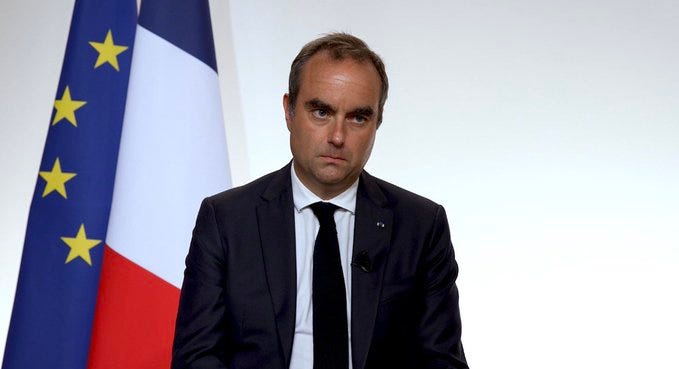
Starting off the week: the French government is currently suffering a headache over the incoming budget negotiations for 2027, with one leaked proposal creating an uproar that Sebastien Lecornu’s Matignon had to spend Monday distancing itself from.
The big proposal was to tax employee savings to help plug the 2027 social security budget, in a government still without a parliamentary majority and running out of room to manoeuvre before next year’s presidential election.
This also comes as bubbling exasperation grows over the obsessive protection of pensions in France, with stories regularly emerging about retirees earning more, sometimes by a substantial amount, than people in full-time roles. Presidential candidates have also been working to court a pensioner vote, offering whatever they can.
The story began with Les Echos, which reported that the government was weighing new social contributions on profit-sharing bonuses, participation payments and employer top-ups to savings plans. Each of the three mechanisms would reportedly retain its own 3,000-euro exemption, assessed separately, with only amounts above that threshold subject to new contributions.
Economy minister Roland Lescure confirmed as much on RTL that morning, calling it “part of the tracks we’re looking at, like others.” By evening, Matignon was drawing a sharper line, telling reporters that Sébastien Lecornu had “never spoken in favour” of the idea.
He was not simply managing a bad headline. Le Parisien reported that Lecornu “was starting to have enough, you could feel it,” according to one minister close to the Prime Minister, who added: “we’re at a point where we should all have an interest in helping Lecornu get this budget through.”
The PM’s office, naturally, argued that the leak had gotten ahead of the process: “What leaked is a working document, not a government decision,” Matignon said, adding that “ministers hadn’t validated it either” and reminding everyone that the civil service was constantly testing dozens of options “precisely so the prime minister can then accept, modify or discard them” as part of an intellectual exercise to find a path forward.
More strikingly, Matignon announced it had referred the leak of these “internal works” to the Paris public prosecutor under article 40 of the code of criminal procedure, the provision obliging officials to report suspected crimes.
Lecornu’s entourage was careful to draw a line around who exactly was in the crosshairs: “The press is not the target,” Matignon told Le Parisien, “journalists are doing their job.”
Lecornu himself had already made his irritation known on X, writing that having “working information, some of which never even reached Matignon, sometimes liable to directly touch on economic or patrimonial interests,” turn up in the press was “not trivial. It’s serious, even,” and that arbitrages would be announced only once they had actually been made. The detail that some of what leaked never reached Matignon at all points the finger lower down the chain than ministers.

The justification leaned on market sensitivity rather than simple embarrassment, and the stakes were not hypothetical. France’s 10-year borrowing rate hit 4.25% on Monday, its highest since 2008, with markets weighing a debt load above €3,500 billion, a fresh €310 billion in bonds due to be issued this year, and annual interest charges above €77 billion.
Matignon tied its own reasoning explicitly to this backdrop: premature disclosure, it warned, was “likely to affect the country’s economic life,” pushing businesses and individuals toward investment decisions “based on erroneous information.” “The overall framework for preparing the budget cannot be disconnected from the context in which France borrows on financial markets,” Matignon added, warning that “any needless swing in rates could, in turn, cost every French person,” and that the leaks potentially amounted to “abuse of trust or a breach of professional secrecy.”
If anything, Matignon suggested, Lecornu’s actual instinct runs the other way. Rather than taxing employee savings, the government wants to explore “how to temporarily let employees more freely access savings they’ve already built up.” This is presumably also to give French citizens a little more economic freedom at a time when the Russian invasion of Ukraine, the American war in Iran, and inflation are battering French wallets.
To that end, Matignon reiterated its backing for a bill from LR senator Olivier Rietmann, passed by the Senate in the spring, that would allow employees to draw down up to €5,000 from their savings plans. The PM has asked the minister for relations with parliament to schedule its passage through the National Assembly, in keeping with the value-sharing measures introduced under Macron.
Medef was not waiting to find out how the arbitrage would land. The employers’ federation came out against the tax idea on Monday, insisting employee savings were not “a budgetary reserve” but “the fruit of labour and of collective success.” It called on the government to strike the option from the social security financing bill, arguing it was incoherent to preach better value-sharing while “making these arrangements less advantageous for employees as for employers.”
The episode sits inside a wider budget squeeze. With public finances under strain and growth weak, Lescure said savings would instead have to come from “operating expenses of the state, local authorities, social security administrations, all public agents,” and repeated that Lecornu “doesn’t want a new tax, an additional tax increase.”
Lecornu used the RTL interview to needle opposition parties threatening to censure the budget, contrasting the comfort of opposition with the burden of government: “It’s easy today to say: frankly, this budget, I don’t like it, I’m censuring it,” warning that a country without a budget would eventually hit a wall, “with interest rates rising very sharply” for households.
However, Lecornu’s allies were unimpressed by the whole situation. Frédéric Valletoux, the Horizons MP who chairs the National Assembly’s social affairs committee and had publicly opposed the tax idea along with much of the bloc central, called the climbdown “a wise announcement” in comments to Le Parisien, before adding a complaint of his own: “these trial balloons we keep launching are tiresome, this way of doing things ends up being tiresome, and it gives the impression the government is a bit cornered.”
What stands out is not the tax idea itself, killed off before it reached a minister’s desk, but the reach for article 40. Reporting a leaked working document to the prosecutor is a heavy-handed tool for what is, on Matignon’s own account, an unremarkable stage of budget drafting: officials constantly float and discard options.
Valletoux’s own aside, that the government looks “a bit cornered,” is close to confirmation from inside the coalition of what the manoeuvre otherwise only implied. A government running month to month without a majority has little appetite for its internal arbitrages being narrated in real time, particularly when the option in question would have handed the opposition, on the left and at the RN, a ready-made tax increase to campaign against ahead of what will be decisive presidential elections for the French economy.
That is presumably the real logic behind steering toward the Rietmann bill instead: letting people unlock savings they already hold costs nothing to sell and echoes the value-sharing bonus Macron championed in his own presidency.
📉Lescure lowers French growth outlook
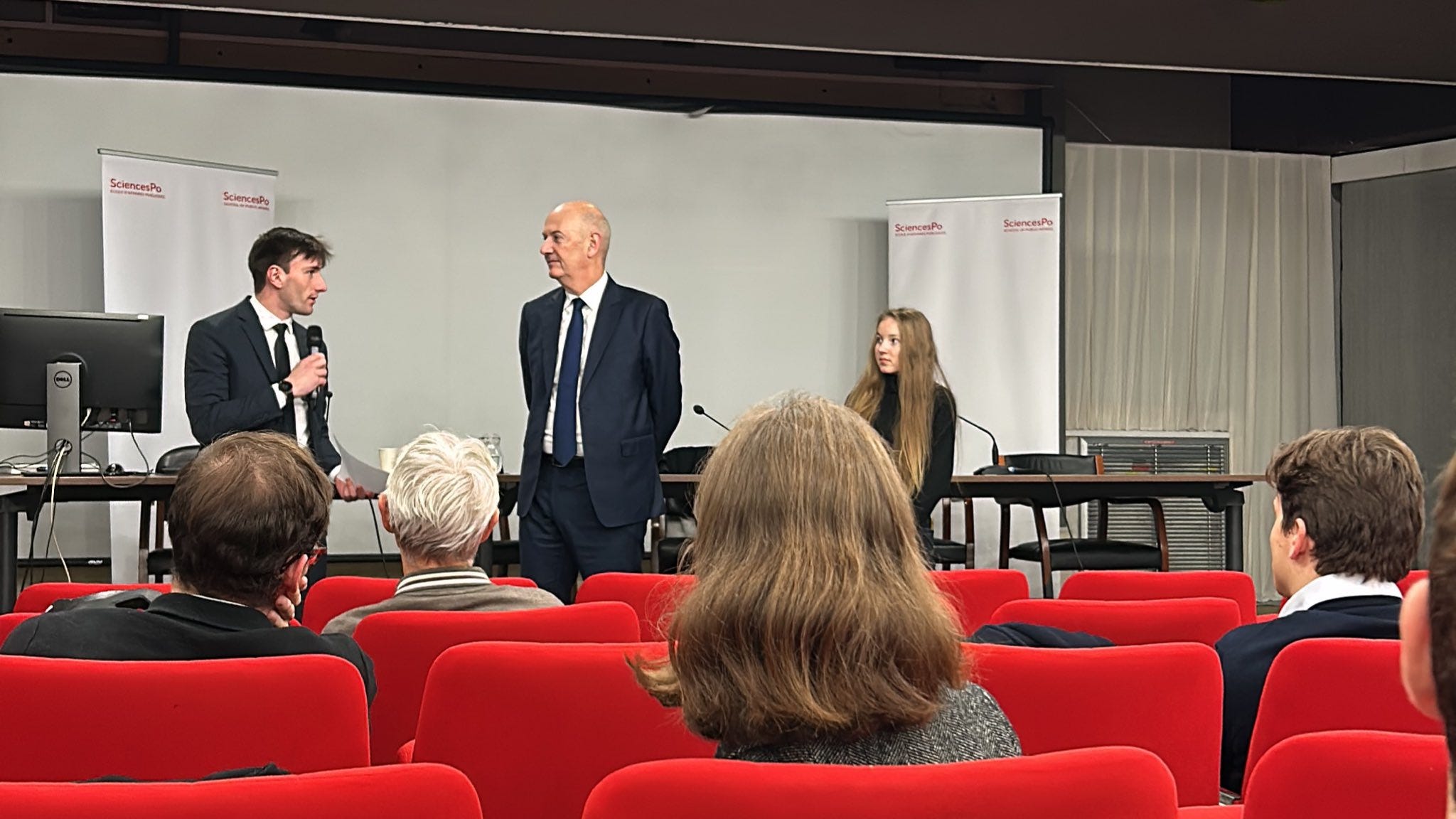
France’s finances took another hit on Friday, when finance minister Roland Lescure confirmed the country will grow less than expected this year and miss its own budget deficit target, complicating an already precarious path to getting the 2027 budget through a deeply divided parliament before next spring’s presidential election.
Lescure cut the government’s 2026 growth forecast to 0.5% from 0.7%, while leaving the 2027 projection unchanged at 1.0%. “This year has been marked by extreme crises involving four different types of shocks,” the minister told reporters, listing domestic political uncertainty, surging energy prices, extreme summer weather and a jump in borrowing costs on bond markets as primary reasons for the change.
The deficit target is now firmly out of reach for this year, with the government having planned to bring the shortfall down to 5.0% of GDP, a goal built on assumptions that the weaker growth outlook has quietly demolished.
“The reality is that the budget was built on a 5% assumption. And the reality is that, today, 5% is no longer an option,” Lescure said. He did not offer a replacement figure, saying only that the government was still finalising the budget bill it is due to present to parliament at the end of the month.
Markets have already drawn their own conclusions. As the deficit target slipped away, the premium France pays to borrow over ten years, relative to Germany, widened to its highest since 2012.
And what’s worse is that polls are pointing to a possible presidential run-off between Marine Le Pen and Jean-Luc Mélenchon, meaning investors are bracing for the economic situation to become even more complicated and for the spread to widen even further. “I think we are at the foothills of something more concerning for France,” James Athey, a fixed income manager at Marlborough in London, told Reuters: “The spread at the moment is not pricing all the risks. It is not pricing a Le Pen or Melenchon presidency.”
Lescure pinned part of the blame on forces outside the government’s control. The economic fallout from the American war in the Middle East, currently stuck in a quagmire as Iran resists and the Houthis run riot, along with summer heatwaves and drought that hit agricultural output, dragging down growth and pushing the fiscal targets further out of reach. “I think it is reasonable to say that economic uncertainty has never been greater than it is today,” he said. “We are operating under tight budgetary constraints; there is no more fat to trim.”
The borrowing costs are not abstract. Investors have started treating France as one of the weaker links in a broader global bond selloff, a judgment rooted in weak public finances and a now familiar pattern of missed deficit targets.
Lescure insisted France still has no trouble issuing debt, though he conceded it costs considerably more than it used to, calling the risk premium over German bunds “too high.” The bill for that premium is concrete: debt servicing will cost France €65 billion this year, €4.5 billion more than originally budgeted, and now the single largest line item in the entire budget.
Taken together, the numbers describe a government trying to pass an unpopular budget through a parliament with no majority, while the market backdrop against which it is negotiating keeps getting worse.
A growth downgrade and a missed deficit target would be awkward in any year. Arriving months before an election where the two candidates furthest from fiscal orthodoxy are polling strongest, they read as a warning the bond market is already pricing in political risk the government has yet to publicly reckon with.
This is less a new story than the same one deepening. Three weeks earlier, Fitch had kept France’s rating at A+ but flagged “persistent political fragmentation” as a “major weakness” that “reduces the authorities’ capacity to implement a durable budgetary adjustment,” while INSEE was quietly revising second-quarter growth down to a flat 0.0%, putting the country within a whisker of a technical recession. Friday’s downgrade and missed deficit target read less like a shock than confirmation of what the rating agency and the national statistics office had already been pricing in.
You can read about these in the following link:
France Eyes Sweden Fighter Jet Deal as Recession Fears Mount

Macron pitches Sweden as an FCAS replacement, Fitch holds France at A+, INSEE flags recession risk, plus Delogu's arrest and Iceland's EU vote.
The government keeps finding technical language to describe each threshold it hasn't crossed yet — not a recession, not a new tax, not a downgrade, and each time, the language survives a little less contact with the numbers underneath it as the French continue to ask what exactly is going on
Plus, you can almost hear Marine Le Pen and Jean-Luc Mélenchon rubbing their hands together.
✈️France moves on from FCAS with new Rafale

So, to wrap up the week: as France competes to court Swedish company SAAB to fill in the FCAS project, the French government is working on a new configuration of its famous Rafale fighter jet.
For some background knowledge, here’s an in-depth post-mortem on the FCAS Scandal:
The Death of FCAS: an Anatomy of Europe's €100 Billion Defence Scandal

The story of how the Franco-German fighter was killed, how Germany had its replacement ready beforehand, and what it tells us about Europe's sovereignty drive.
France is accelerating work on the Rafale F5 standard, as TWZ’s Thomas Newdick reported this week, bringing forward the development of a major new configuration of its combat aircraft; at the same time, its planned next-generation fighter with Germany has effectively collapsed in its original form.
The French defence procurement agency, the DGA, has ordered the first upstream development work for F5 from Dassault Aviation, Thales, MBDA and Safran, covering the equipment judged to carry the highest technical risk: navigation, datalinks, radar, electronic warfare and propulsion, ahead of the overall F5 development contract expected by the end of this year.
The DGA confirmed the order on X, listing the inertial navigation system, engine, radar, and self-protection suite as the first areas to be covered.


The F5 was originally conceived as a bridge, keeping the Rafale relevant until the Franco-German New Generation Fighter (NGF) was finally developed and became France’s principal crewed combat aircraft. However, with the now well-known scandal having killed the FCAS, the F5 will be expected to take on a far larger role in the meantime: rather than a stopgap, it is being built to carry French tactical aviation through the 2030s and potentially beyond, entering service with the Air and Space Force, as well as the French Navy, from sometime around 2033.
The scope reflects that shift: previous Rafale standards were largely incremental, software and systems tweaks to an existing configuration. The F5 goes considerably further, rebuilding how the aircraft senses the battlespace, communicates and defends itself.
The centrepiece is Thales’s RBE2-XG radar, built around gallium nitride semiconductors that the DGA says will deliver “a substantial increase in power, and consequently in detection range, as well as improvements in the identification of targets with an extremely low radar cross-section,” with computing capacity enhanced to support AI integration and sensors “designed with collaborative combat in mind.” MBDA and Thales are also separately overhauling the SPECTRA self-protection suite through, in the DGA’s words, “a fully digital approach, enabling a complete overhaul of the core electronic warfare system” to counter threats expected to be common by 2035, while Thales’s new Inter-Vehicle Data Link is meant to let the Rafale “penetrate hostile areas where jammers are widespread, while maintaining optimal quality of communication.” Safran, meanwhile, will begin design work on an upgraded M88 engine intended to boost thrust by roughly 20%.
On the weapons side, the F5 is set to carry the ASN4G, a hypersonic nuclear-capable missile with a range beyond 1,000 kilometres, keeping the Rafale as France’s airborne nuclear delivery platform, alongside a new beyond-visual-range missile under MBDA’s Comet programme meant to succeed Meteor around 2030.
As Newdick noted, the programme also lets France sidestep NGF’s now-defunct joint structure altogether, freeing it from having to negotiate requirements, industrial structure, and workshare with Berlin on a single aircraft. Working alone, France can fold in NGF-era concepts, crewed fighters operating alongside drones, remote carriers and offboard sensors, without needing Germany’s agreement on any of it.
A heavily upgraded Rafale, serving as the crewed controller for uncrewed combat aircraft, has the potential to deliver much of what the NGF was meant to deliver. However, with the Rafale airframe dating back to 1980, experts and observers will also continue to ask themselves how long the fourth-generation Rafale fighter jet can underpin the French strategy for air superiority, especially as fifth- and sixth-generation fighters continue to be developed and will begin to be deployed in combat zones.
There's an industrial logic underneath this too, outside the purely military picture: Dassault, Thales, Safran and MBDA, the same four companies that would have formed the backbone of the French lead on FCAS, are now the ones building the F5 together, and keeping that partnership and its expertise intact for whatever comes next, whether that is a future crewed fighter, an uncrewed combat platform built on lessons from the nEUROn programme, or both, is essential for the French effort.
Britain, Italy and Japan are already pushing ahead with their own GCAP programme, and Germany and Spain remain tied to the wider FCAS architecture even without France, though Germany in particular has reportedly been pushing to escape it and join GCAP instead, with Italy said to be open to the idea.
There’s a domestic subtext worth noting too. This commitment lands in the same week Roland Lescure was insisting there is “no more fat to trim” in the budget, and just three weeks after Fitch cited extra defence spending commitments as one of the reasons it revised France’s own deficit forecasts upward.
Out of everything on the table this budget season, defence procurement (alongside pensions) is the one line item that keeps expanding, regardless of who is in government or how tight the fiscal picture gets, a rare point of consensus in a parliament that agrees on almost nothing else.
Thank you for reading the French Dispatch! If you liked what you read, you should like this post and subscribe to the newsletter by clicking/tapping the button below:
And if you’d like to contribute a coffee or two to help fuel my coverage of the wild world of politics, feel free to click on the picture below:
