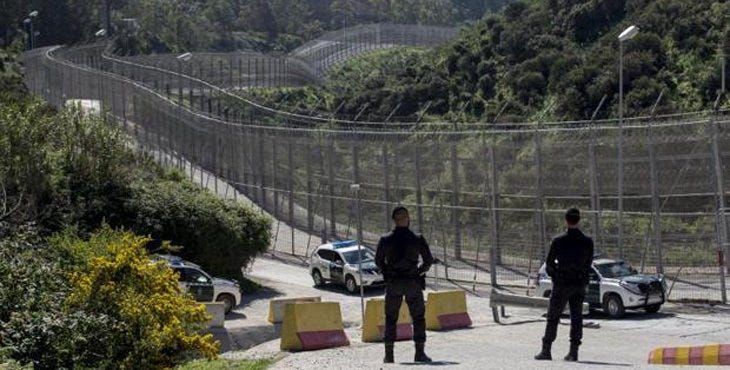
Nobody Is Going to War Over Ceuta or Melilla
Four coercion crises since 2021, one use of force since 2002, zero wars. What changed is Rabat's diplomatic cover in Washington, not its appetite for a pointless and self-destructive fight.

👋Hey guys, Julien here. The French Dispatch is a reader-supported publication, and both our coverage of current affairs as well as our ability to bring you more news and information on the world around us is entirely funded by paid subscriptions and donations.
If you enjoy reading articles written by high-level experts, then make sure to support the publication by liking, subscribing, and sharing it with your friends and colleagues, and consider taking a paid subscription.
Every time Ceuta is targeted with one of Morocco’s hybrid attacks, and every time the lives of migrants are abused to pressure the Spanish government, someone always asks whether Spain and Morocco are heading for war.
They don’t care about the problems with this type of geopolitical posturing. They don’t care about the needless endangering and loss of human life. They don’t even care about who is doing what. They just want to posture in the news or on social media about how powerful Morocco is, how powerful Spain is, and how x, y or z could annihilate a, b and c in retribution for perceived or real slights.
Naturally, with the ongoing aftermath of the Ceuta crisis, the question resurfaced within hours of the July crossings, with journalists and keyboard warriors alike spreading their messages of peace and love across the internet; and once a US congressional committee waded into the question of Spanish sovereignty, it stopped being confined to comment sections.
Naturally, it also happens to be the wrong question, or rather it collapses two separate questions into one. Whether Rabat will keep using migration as leverage over Madrid is not in doubt: it has done so four times since 2021 and will continue to engage in hybrid warfare. Whether either government would risk actual armed conflict over two North African cities is a different matter, and the historical record answers it plainly.
None of what follows is a celebration of European or Spanish strength, or an invitation to read the numbers as a scoreboard. That framing is exactly the problem it's meant to correct. Morocco has nationalists who profit from portraying Rabat as an unafraid rising power. Washington has acquired its own, who have adopted Ceuta as a front in a culture war that has nothing to do with it, using the crisis as a purely punitive attack on Pedro Sánchez. Meanwhile, Europe's far right needs a foreign threat to sell domestic politics it otherwise couldn't. All three are currently misreading, or deliberately misrepresenting, a pattern of coercion that has stayed remarkably contained for two decades. Setting that record straight, not tallying tanks, is the point of what follows.
To begin with, it’s possible to set up frameworks to better understand the likelihood or probability of a conflict, but it’s not bulletproof and it’s not a crystal ball. The history of geopolitics is filled with rash decisions that make little sense and are looked upon in the eyes of history with bafflement and confusion.
Any question about whether two states might fight, with all of the myriad of reasons, benefits from being broken into smaller stages rather than treated as binary yes or no.
A useful model runs on four rungs:
Diplomatic pressure – Protest notes, recalled ambassadors, sharpened rhetoric. The baseline state of any contested-sovereignty relationship, present continuously between Madrid and Rabat since independence. It escalates only when one side judges words are no longer being taken seriously
Coercion short of force – A costly signal that stops short of combat, most often trade restrictions or, in this case, a loosened border. The clearest precedent is Belarus’s 2021 push of migrants toward Poland and Lithuania, which the European Council formally condemned as a “hybrid attack,” a label that has stuck for this kind of coercion ever since. The point isn’t the crossing itself but what it demonstrates: Rabat’s ability to impose real cost on Spain at will. This is where every Ceuta and Melilla crisis since 2021 has played out, and where each has been resolved once the signal landed
Limited use of force – An operation small and reversible enough that neither side has to call it war, seizing an islet, a border skirmish, a naval intercept. Reaching this rung means coercion has failed to extract the concession sought, or one side judges the other won’t actually shoot back. Perejil in 2002 is the only time this ladder has been climbed this high, and it was resolved within days precisely because both sides moved fast to keep it there.
Full-on interstate war – Mobilised forces, combat, contested territory. States arrive here only when no bargain both sides trust can be found, typically because one side doubts the other’s resolve, or because a closing window makes fighting now look better than fighting later. Neither condition holds between Madrid and Rabat: Spanish resolve has never been in doubt, and Morocco faces no closing window that rewards acting before talking. This rung has never been reached.

That “why” has a well-established answer in the study of interstate conflict. States rarely go to war because grievances accumulate past some threshold; they go to war when no bargain both sides prefer to fighting can be found and trusted.
Sometimes this can be because one side doubts the other’s resolve and miscalculates a fight it would have avoided had it known the truth. More often it’s a commitment problem: a rising power doubts a declining one will honour today’s terms once the balance shifts, or doubts that the opponent can defend itself with sufficient material or manpower that would prevent unacceptable losses.
So, it fights while the fighting is still favourable. Occasionally the prize itself can’t be split: a capital, a city, a holy site, a currency union, and no bargain exists that would allow complete ownership over the goal in the first place.
Morocco’s claim to Ceuta and Melilla clears this particular hurdle easily: sovereignty over an inhabited city isn’t divisible the way a trade dispute is, particularly not one found within what it considers to be its sovereign territory.
What Morocco has never fully cleared is the next two rungs on the ladder: Rabat has never doubted Madrid’s resolve to defend the enclaves with military force if necessary, and it has never faced a closing window that made waiting look riskier than acting now. Absent either failure, coercion below the threshold of force stays the rational choice, which is exactly what the record below shows it choosing, four times over.
Four crises since 2021, one weapon in two decades
The Perejil crisis is the exception that proves the rule. When Moroccan marines occupied the uninhabited islet off Ceuta in July 2002, Spain retook it within a week using a small commando unit during Operation Romeo-Sierra, without a single casualty on either side.
Washington, under more intellectual leadership than today, brokered a return to the pre-crisis status quo within days, and Madrid’s government publicly thanked the United States for its role, with ambassadors restored to their positions the following January. In over two decades of recurring friction between Madrid and Rabat, it remains the only episode that involved anyone firing up a helicopter or a potential risk of life rather than loosening a border fence.
Everything since then has stayed several rungs lower. In May 2021, Morocco relaxed border controls after Spain admitted Polisario Front leader Brahim Ghali for hospital treatment, and roughly 8,000 people crossed into Ceuta over two days. The dispute was resolved through policy rather than force: Madrid reversed its position on Western Sahara the following spring.
In June 2022, around 2,000 people attempted the Melilla fence; the official Moroccan toll rose from an initial 18 to 23 confirmed dead, with Moroccan human rights groups citing higher figures still. That crisis, too, resolved through diplomacy rather than escalation, arriving as it did a month after Rabat and Madrid had already patched up relations. A smaller episode followed in August 2024, when several hundred people used fog cover to swim into Ceuta.
Then came the most recent flashpoint in July 2026.
Spanish authorities said 72,000 people crossed over two days, considerably more than any previous episode, with at least 67 confirmed dead by the time Spain began installing a floating barrier off Tarajal beach. The toll continued climbing as recovery operations proceeded in both Spanish and Moroccan waters, reaching at least 141 dead by early August, more than double the initial count and Morocco’s deadliest migration disaster on record. The mechanism was the same as 2021: a loosened border, a diplomatic grievance behind it, a return to the status quo once the political point had been made. What was different was the scale, and, as it turned out, the audience watching from Washington.
Coercion is cheap, whereas war would not be
The reason Morocco reaches for migration and hybrid warfare rather than anything sharper is not squeamishness; it’s arithmetic.
Spain’s defence budget runs to roughly $34.5bn against Morocco’s $6.2bn, and that comparison understates the real gap between the two states: Spain is one of 27 EU member states bound by Article 42.7 of the Treaty on European Union, the bloc’s mutual defence clause. It has been invoked once, by France after the 2015 Paris attacks, and it does not trigger automatically.
However, the simple reality is that the EU-27 spent €418bn on defence in 2025 alone, more than seventy times what Morocco spends on its entire military in a year, and that is the backdrop against which any Moroccan planner has to weigh an escalation of the Perejil precedent.
The trade relationship tells the same story from a different angle. Morocco sends 22.5% of its exports to Spain alone, more than to any other country including France, and Spain has become Morocco’s largest African trading partner, worth over €22bn a year. Widen the lens to the EU as a whole and the exposure grows further still: total EU-Morocco goods trade reached €62bn in 2025, with Spain alone accounting for well over a third of Morocco’s trade with the bloc. Migration pressure is a lever Rabat can pull and release at will, deniable and reversible within days. Losing access to the Spanish or European market is neither, and Rabat has spent two decades demonstrating that it knows the difference.

None of this restraint is happening by accident, or out of pure strategic patience either. As I argued after the emergency Justice and Home Affairs meeting on 4 August, and discussed live with Dave Keating from Spain that same week, Brussels' instinct throughout this crisis has been damage control rather than accountability: a four-day reversal from criticising Madrid to closing ranks around it, Morocco never named in the official readout, and the Commission reportedly offering Rabat more money rather than answers.
European leaders embarrassed themselves over Ceuta
Sanchez' Spain swiftly dealt with the incursion of 60,000 Moroccan migrants sent to Ceuta as part of Morocco's hybrid warfare strategy, and after showing zero solidarity, anti-EU leaders backed down.
That is not the behaviour of an actor confident enough to escalate. It is the behaviour of one that would rather pay to make a problem go away than find out what happens if it doesn't.
What Brussels has and has not used.
The EU’s Anti-Coercion Instrument, in force since December 2023, lets the bloc restrict a coercing country’s access to the single market, tariffs, procurement, investment, in response to political pressure applied through trade. It has never been triggered, requires a minimum of six months to activate, and is designed, in the Commission’s own language, to work best if it never has to be used at all.
Article 42.7 sits alongside it as the harder-edged option: a mutual defence obligation that requires the attacked state to invoke it first, with no automatic collective response.
Neither has come anywhere near Ceuta. Nobody in Brussels has needed to reach for either, because nobody in Rabat has given them a reason to.
Congress didn’t arm Morocco. It told Rabat the claim now has friends
What actually shifted this summer sits in Washington rather than Rabat or Madrid. A House Appropriations Committee report accompanying the 2027 State Department funding bill stated that Ceuta and Melilla are “located in Moroccan territory,” the first time any chamber of the US Congress has cast doubt in writing on Spanish sovereignty over the enclaves.
The House passed the underlying bill 217 to 209 on 15 July, before the crossings began, and the report effectively carries no legal force. Official US policy has not moved: Washington still recognises the cities as Spanish. The same bill directs $40m toward Moroccan security programmes, well under 1% of Morocco’s own annual defence budget and not remotely enough to alter the balance described above.
What has changed is the relationship the report landed inside.
Spain and the United States have spent most of 2026 in their coldest situation in decades. In February, Sánchez refused US forces access to Spanish bases for the strikes on Iran and closed Spanish airspace to the aircraft involved, and in March, Trump ordered a halt to all trade with Spain, a threat that went unfulfilled but was never formally withdrawn either. Spain remains the only NATO member that has not committed to the alliance’s 5% of GDP spending target, which Sánchez has called “unreasonable and counterproductive,” and Madrid spent the same stretch deepening ties with Beijing, the prime minister’s fourth visit to China in four years came in April.
A brief thaw occurred in July: a cordial handshake at the World Cup final in New Jersey, after talks at a summit in Ankara, but this level of public friction doesn’t dissolve over one football match. A House committee willing to question Spanish sovereignty over Ceuta and Melilla isn’t an isolated event, it is a signal that is received very loudly by those who would benefit from it the most.
The military calculus hasn’t moved. What has moved is the political one. A claim that spent two decades confined to Rabat’s own rhetoric and a scattering of sympathetic think-tank essays has now appeared, in writing, inside a committee report of the world’s most powerful legislature.
Spain’s legal position is unaffected: it rests on possession predating the modern Moroccan state by centuries, and no US administration has changed its recognition of Spanish sovereignty due to the domino effect it would have across its alliances and relationships.
What Moroccan officials gained is a talking point they didn’t have in May, and what future advocates of the claim gained is an institutional citation to point to instead of an op-ed. Normalisation is a slower, cheaper form of leverage than anything involving a fence or a flag, and it is exactly the kind of leverage this Congress has shown itself willing to hand out.
The bill itself is still sitting with the Senate, unresolved, and no secretary of state under any recent administration has agreed to broker talks on the cities’ status, whatever a single House committee chooses to note in a report nobody outside Brussels and Rabat had heard of a year ago.
The question worth tracking from here is not whether Madrid and Rabat go to war over Ceuta, they will not, but whether this kind of language outlives the Trump administration that produced it. A House report is reversible. A precedent, once set, rarely is.
Thank you for reading the French Dispatch! If you liked what you read, you should like this post and subscribe to the newsletter by clicking/tapping the button below:
And if you’d like to contribute a coffee or two to help fuel my coverage of the wild world of politics, feel free to click on the picture below:


