


👋Hey guys, Julien here. The French Dispatch is a reader-supported publication, and both our coverage of current affairs as well as our ability to bring you more news and information on the world around us is entirely funded by paid subscriptions and donations.
If you enjoy reading articles written by high-level experts, then make sure to support the publication by liking, subscribing, and sharing it with your friends and colleagues, and consider taking a paid subscription.

This week
💰EP Demands €206,000 From Bayrou’s MoDEM
🛑Les Écologistes suspend Jadot for backing Glucksmann
⛽Macron sends troops to fix fuel prices
💰EP Demands €206,000 From Bayrou’s MoDEM
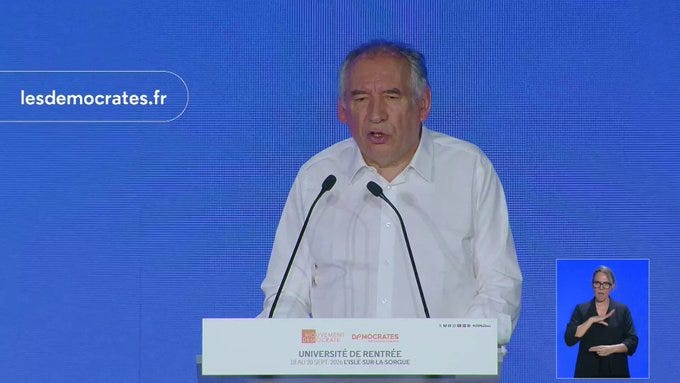
Right, kicking the week off with some good old corruption: the MoDem parliamentary assistants trial continues, but the whole affair is a little harder to conclude than the cut-and-dried, €4.5 million far-right scheme led by potential French president and convicted criminal, Marine Le Pen.
The appeal opened on 9 September, with François Bayrou and ten co-defendants, former MEPs and party officials, answering charges of misappropriating funds in a decade-old file in which the former prime minister had been acquitted at first instance.
Le Pen Convicted: Three Years Prison, €100k Fine, but Eligible for the Presidency

The clock, not the bench, just cleared her for a 2027 run, but whether Marine Le Pen will run a campaign wearing an ankle tag or not is the question the Rassemblement National now has to answer.
After nearly three weeks of hearings, the European Parliament’s two lawyers kept their promise to be brief on Friday, which, by the standards of the Paris bar, may as well be self-denial. Patrick Maisonneuve, who also carried the Parliament’s successful case against the Rassemblement national, immediately attacked the defence’s favourite argument: that the rules on assistants were too muddled for anyone to know they were breaking them.
The rule has never changed, he told the court. An assistant works for their MEP, exclusively and within the mandate, and work for the party has no place in their contract.
Each MEP gets a monthly allowance to hire staff (€17,000 twenty years ago, around €30,000 today) and signs contracts under French law that bind them personally.
Maisonneuve was frank about the weak spot: the Parliament’s finance directorate has only ten officials to check 6,500 contracts across 730 MEPs, and looking too closely at an assistant means looking at the MEP, whose independence is protected. That is how eleven contracts could run for years with the assistants working almost entirely for the MoDem.
Now, while this seems fairly cut-and-dried, the first-instance court convicted only five former MoDem MEPs in February 2024, handing suspended prison sentences to Jean-Luc Bennahmias, Janelly Fourtou, Thierry Cornillet, Anne Laperrouze and Bernard Lehideux.
On the eleven disputed contracts, for which the Parliament then claimed €293,000, the court cleared Bayrou after finding “no document” showing he had asked MEPs to employ assistants fictitiously. Three days later, the Paris prosecutor appealed, arguing that the evidence against every defendant was in the file.
Bayrou and his lieutenants now argue that the party’s finances were healthy and that, therefore, there was no motive. Maisonneuve disputed the premise, pointing out that the MoDem laid off two-thirds of its staff in 2012, and added that breaking the law without needing to is closer to an aggravating circumstance than an excuse.
His colleague Bérénice de Warren took the drier legal ground. The defendants, she noted, do not claim ignorance of the rules, only that they never broke them, which sits awkwardly with Bayrou’s own recorded warning that the party had to be careful or it would be held against them. She argued that Article 432-15 of the penal code on misappropriation of public funds applies to MEPs as holders of a public-service mission, a point every party facing these charges has contested, from the RN to the MoDem. Of some 130 contracts examined, only eleven reached trial, because investigating judges dropped any file with a trace of genuine work. What remains are jobs that existed and were diverted to the party.
Nobody disputes that MEPs handed a third of their staff allowance to the “delegation”, the informal group of MoDem MEPs chaired by the late Marielle de Sarnez. The Parliament wants its €206,000 loss confirmed plus €100,000 in moral damages. Bayrou, who opened the appeal “deeply confident” the court would confirm his acquittal, hears the parquet général’s réquisitoire on Monday, with hearings scheduled to close on 5 October.
🛑Les Écologistes suspend Jadot for backing Glucksmann
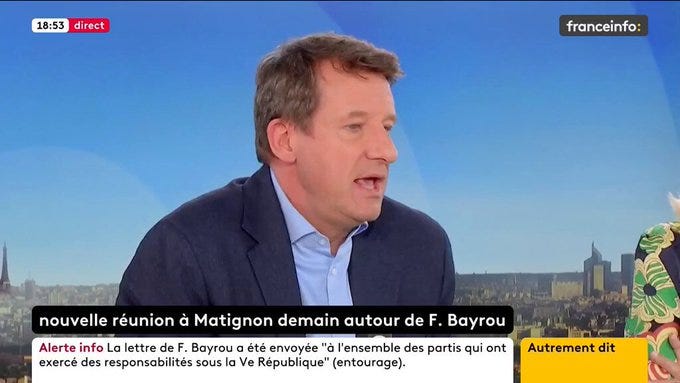
To move on to a funnier story: according to reports by Le Monde, Yannick Jadot, the party’s 2022 presidential candidate and now a senator for Paris, has been suspended for three months as a precautionary measure. Marine Tondelier’s team says the offence is officially backing someone other than the party’s designated candidate, who is Tondelier herself. The party’s letter, first reported by La Tribune, also asks him to stop speaking on behalf of the party in public.
The part Tondelier is not saying herself is that she’s currently polling at 3% regardless of what happens.
Jadot came out for Raphaël Glucksmann on France Inter on 24 August, the morning after the Place publique leader announced his candidacy on TF1, declaring his support “without hesitation and with enthusiasm”. Glucksmann has since put him in charge of managing the “ecological state of emergency” in his programme.
What finally tipped the party over was his plan to appear under Place publique colours at a debate on pesticides on 10 October, where the Greens will be represented by Benoît Biteau. Unfortunately, the French ecologists don’t feel confident enough in their ability to outperform now-suspended member Jadot.
Who, for those who know, is not known for backing down. “I am and remain an ecologist,” he told Le Monde, accusing the Greens of resigning themselves to watching passively while the political situation grows more dangerous.
When he first endorsed Glucksmann, he said political ecology was in no position to unite the left or win in 2027, which is an uncomfortable thing to hear from the man who took 4.6% last time out. Tondelier is also not helping herself or her party by suspending the most recognisable ecologist in France for saying the party cannot bring people together, which is one way of proving his point.
The suspension of Yannick Jadot also tells you which way the leadership leans. In June, the party’s federal council voted through a rule allowing the exclusion of any member who backs a rival candidate, a text its critics said was written for two people: Jadot and Sandrine Rousseau.
Rousseau, known as an anchor of the far left, then immediately went on Sud Radio to call Mélenchon “the best placed on the left” and told members not to pick Tondelier as their candidate. Only one of the two has been suspended so far, and it isn’t her.
Tondelier’s tone runs the same way: Mélenchon got a polite appeal for “humility” after dismissing the Greens as having no strategy, no candidate, and effectively no future.
Meanwhile, Glucksmann and Boris Vallaud (PS) were accused of claiming a “monopoly on values”, and Glucksmann’s son was dragged unwillingly into a row over the Paris mayoralty for the fun of it.
On top of all of this, with LFI now promising the Greens ministries and Tondelier floating a members’ vote on who to rally behind, the fact that EELV went out of their way to suspend the senator who went to the social democrats, while the MP who went to the Insoumis keeps her card, has made clear where the party's allegiances lie.
⛽Macron sends troops to fix fuel prices
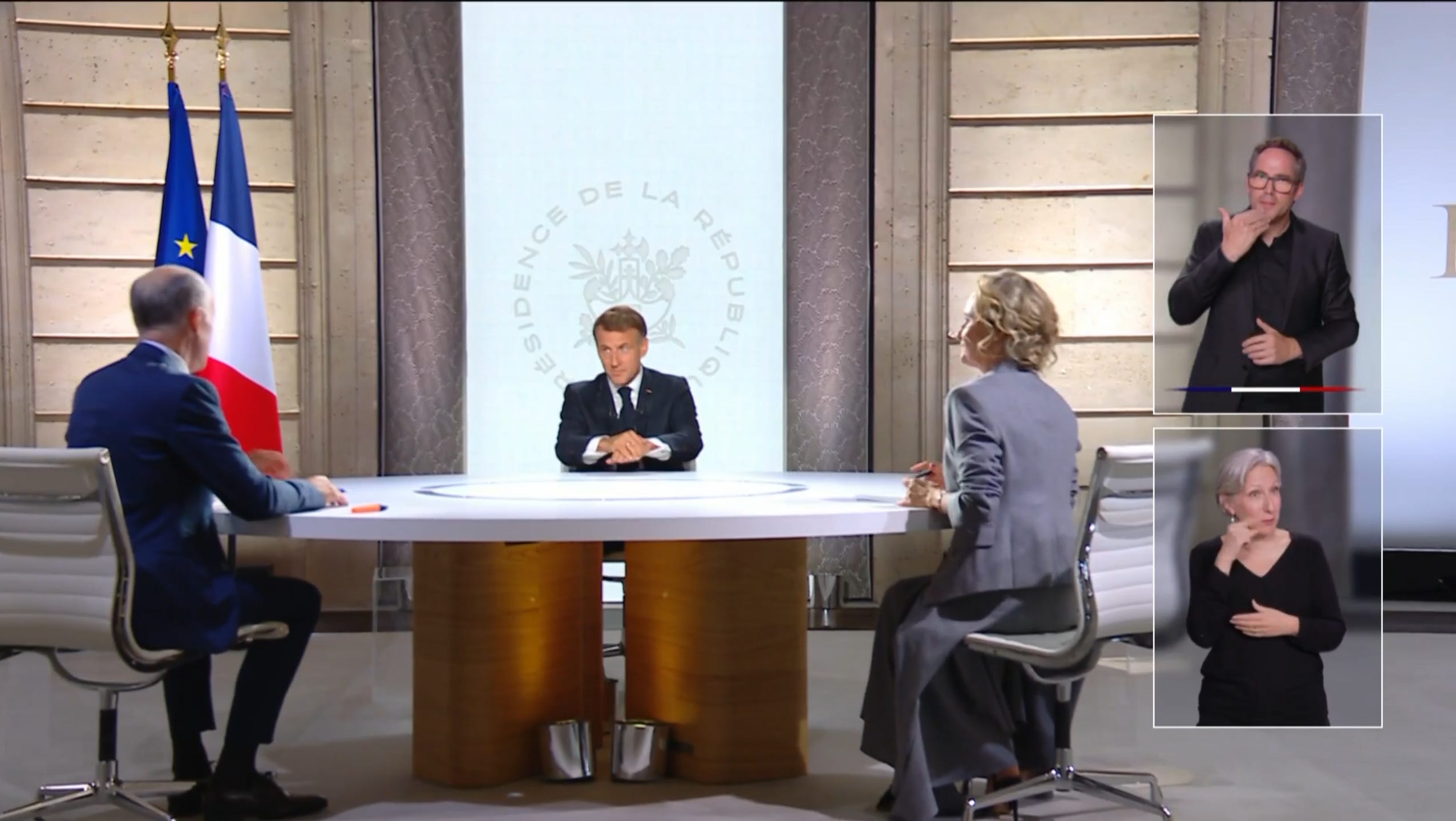
To finish off the week: Emmanuel Macron has found a new answer to the fuel prices hammering French wallets.
In a 40-minute interview on TF1 and France 2 on Thursday, the president announced that France is sending soldiers, radars and air-defence systems to protect Yanbu, Saudi Arabia’s main crude export terminal on the Red Sea and a Houthi target. Rafale jets are not ruled out if the situation demands it, although he insisted France has no intention of joining Riyadh’s war with the Yemeni rebels.
Yanbu sits at the end of the East-West pipeline, the route Saudi crude takes to avoid the Strait of Hormuz, which Iran has effectively closed since the Iran war began on 28 February. With Bab al-Mandab also under pressure, diesel is sitting at a record of around €2.40 a litre.
Macron promised to keep talking to the Iranians and the Omanis to reopen Hormuz, having already asked Donald Trump in New York to back a UN Security Council initiative on freedom of navigation. He also wants the G7 to discuss another release of strategic oil stocks, and to talk Trump out of the diesel export ban he is weighing ahead of the midterms.
At home, the message was that geopolitics caused this, so geopolitics will fix it.
“Our interest is to lower prices before lowering taxes,” Macron stated plainly, before calling tax cuts without spending cuts demagoguery, a jab aimed squarely at the RN, which wants lower fuel duty, and at LFI, which wants a price freeze. He still left himself a way out, insisting there was “no taboo” on a tax cut if prices kept climbing.
As for the social movement the government fears this autumn, Macron suggested that a protest against the war is one he could happily join himself.
The other energy war got a mention too. Macron relaunched his proposal for a double moratorium on strikes against energy and civilian infrastructure in Ukraine and Russia. He warned that France could face a drone attack like the one Le Monde reports hit Leipzig airport in early August, since Moscow sees Europe as Ukraine’s strategic depth, and he called a fresh Russian mobilisation of 300,000 men credible. It was the televised version of the warning he gave party leaders at the Élysée on 18 September.
Macron: “The Day We Are Physically Attacked, We Will Not Be Warned”

Full English text of Macron's 18 September 2026 press conference on Russia's hybrid threat, Donald Trump’s Hormuz crisis, and energy prices.
Julien Hoez
The opposition was not convinced. “If the base is hit, what will we do?” Jean-Luc Mélenchon asked on X, demanding that Parliament be consulted under Article 35 of the Constitution. RN vice-president Sébastien Chenu said French troops had no business in Saudi Arabia, arguing that no defence agreement binds the two countries.
Mélenchon can have his debate, but not his vote, at least not yet. Article 35 requires the government to inform Parliament within three days of deploying forces abroad. That can lead to a debate without a vote, and a vote only becomes compulsory once an operation passes four months. This means Parliament will only have to vote if French troops are still in Yanbu in late January, in the middle of the 2027 campaign, which is exactly when a deployment in a live war zone becomes every candidate’s problem.
Chenu, on his side, managed to be half right for once: France has had a military cooperation and assistance agreement with Riyadh since 1982, but nothing obliges it to defend the kingdom, so this is a risk Paris has chosen freely. The same freedom is also the argument for it: a government that refuses to cut fuel duty has few levers left, and a pipeline that bypasses Hormuz is one of them.
This deployment is also Macron’s method at its most efficient: a quick bilateral deal that needs nobody else’s permission. Everything that would actually bring prices down runs through someone else: Tehran and Muscat for Hormuz, Washington for the diesel ban and the Security Council, the G7 for the stocks. Soldiers can protect a pipeline, but they can’t bring down the price at the pump on their own.
The most revealing part of the evening had nothing to do with oil. Asked about a deficit that hit 5.1% of GDP in 2025, a week before the Lecornu government presents a 2027 budget with €54 billion in savings, Macron said his reforms had stalled “because I did not convince”, which Le Monde called his first admission of the presidency’s major failure.
Germany, Spain and Italy, Macron noted, can afford fuel tax cuts today because they reformed first.
The confession stopped at the reforms, though. On the 2024 dissolution, Macron said he had acted in good conscience and blamed the voters for their choice and the parties for refusing to build a coalition. He ruled out another dissolution before the end of his term, so the next president can rebuild a majority. The instability he refuses to own is precisely what makes a fuel-duty cut unaffordable now, and whoever wins in April inherits both the pipeline and the bill.
Thank you for reading the French Dispatch! If you liked what you read, you should like this post and subscribe to the newsletter by clicking/tapping the button below:
And if you’d like to contribute a coffee or two to help fuel my coverage of the wild world of politics, feel free to click on the picture below:
