Philippe Snubs the Primary as Le Pen and Mélenchon Pull Clear
The Senate rewrites a budget nobody will vote for, while Philippe refuses a primary that Ifop suggests the right badly needs

👋Hey guys, Julien here. The French Dispatch is a reader-supported publication, and both our coverage of current affairs as well as our ability to bring you more news and information on the world around us is entirely funded by paid subscriptions and donations.
If you enjoy reading articles written by high-level experts, then make sure to support the publication by liking, subscribing, and sharing it with your friends and colleagues, and consider taking a paid subscription.

This week
💶The Senate writes a budget nobody will vote for
🗳️Philippe writes a manifesto for a primary he won’t enter
📊Le Pen versus Mélenchon, with a scramble for third
💶The Senate writes a budget nobody will vote for
Wait, I remember this happening the last two years…
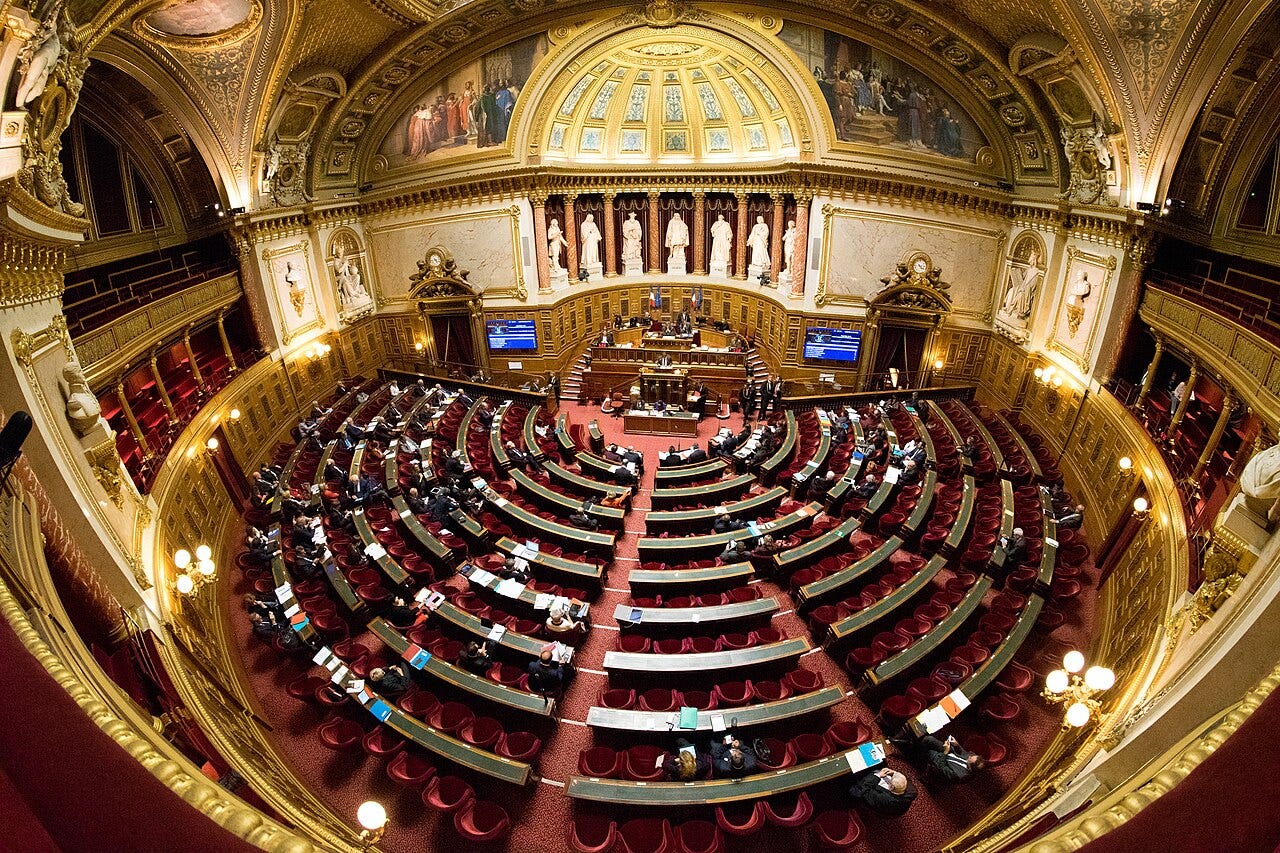
With the Assembly unable to pass either of this autumn’s finance bills, the Senate spent the week attempting to do the job all on its lonesome.
Deputies had rejected the Social Security budget on 23 October by 115 votes to one (that lone vote in favour deserves a medal), and on Wednesday 18 November senators adopted the same text by 201 votes to 124. The state budget is following the same path: the Assembly unanimously threw out its revenue section on 4 November, and the government’s original bill landed in the Luxembourg palace on 19 November, with the debate opening the following day.
What came back from these debates and senatorial work is, unsurprisingly, very much a budget of the Les Républicains-Centrist majority, written for the LR-centrist majority, which will not survive impact with the Assemblée.
Senators scrapped the partial de-indexation of pensions above €1,260 a month and plan to plug the roughly €4bn hole by abolishing retirees’ 10% tax allowance in the finance bill. They pushed the €3.7bn overhaul of employer contribution relief back to 1 April, and still found time to vote a taxe lapin for patients who miss appointments. The deficit target drifts from the government’s €12.7bn to €14bn, an odd place to land for a chamber that spends much of its time lecturing Bercy on rigour and is effectively led by the party known for hammering everyone on fiscal responsibility.
The amendment that actually matters, however, and that will cause all of the drama, went through overnight on 16 to 17 November, when senators restored the 2023 pension reform. That puts the legal age back on course for 64 and saves around €600m in 2027. It also tears up the deal the government struck with the Socialists last autumn, which is the only reason Sébastien Lecornu still has his name on a desk at Matignon, and happened to be one of the main anchors keeping the PS out of the LFI-led far-left alliance.
The minister on the bench, clearly noticing this, replied that the political moment called for “a new reform”, the polite way of telling senators their vote won’t survive the joint committee. Everyone in the chamber knows this, so the vote is best read as a reminder to the PS of what the right would do with a free hand.
What happens next
A joint committee of seven deputies and seven senators (CMP) meets on 26 November to look for a common Social Security text. If it fails, the bill returns to the Assembly, which has the last word. Articles 47 and 47-1 of the Constitution give Parliament 70 days for the finance bill and 50 for the Social Security bill, after which the government can enact both by ordinance.
On the state budget, rapporteure générale Christine Lavarde (LR) has set out her own arithmetic. She wants a deficit of 5% of GDP in 2027 against 5.4% this year, with a further 0.2 points squeezed out (around €6bn), more than €3bn less asked of local authorities, and no Zucman tax. She also described the government’s growth assumptions as “very optimistic”, which in Senate manners is about as close as a rapporteur général gets to calling Bercy’s numbers fiction.
Very little of this will survive intact, if anything at all. Toute l’Europe reckons a CMP deal on the Sécu is unlikely, and with an Assembly vote out of reach, the realistic route is the 49.3. That lets the government rewrite the text as it pleases, provided the RN or the PS declines to censure it. Put simply, the senators are drafting a negotiating document, and the Socialist group holds the pen on the final version.
The clock is the bit to watch. Lecornu may decide that a 49.3 on the last budget of the Macron era is one censure risk too many, five months before a presidential election, and if so, Article 47 offers an unprecedented and potentially explosive exit: enactment by ordinance.
A prime minister who survived by promising to let Parliament decide could end up giving France the first budget of the Fifth Republic that Parliament never adopted at all.
🗳️Philippe writes a manifesto for a primary he won't enter

Gérard Larcher kicked off the week with a letter in which he invited the declared candidates of the right and centre on Saturday 14 November to agree on a method to find a single candidate early next year.
Naturally, the formerly leading centre-right candidate Édouard Philippe, who is currently struggling with a crowded field, responded the following day in Le Parisien with a now well-known reply: “I will not take part in this primary.”
However, he graciously agreed to a meeting with his fellow candidates, with the specific demand that the subject be rassemblement.
By Monday, around a thousand local elected officials had signed a tribune in Le Figaro demanding a primary to avoid a Mélenchon-Le Pen second round, and Bruno Retailleau had already pencilled in 31 January and 7 February for these dates.
By Tuesday, the other centre-and-right candidates had stopped waiting for him, with the campaign directors of Gabriel Attal, Retailleau and David Lisnard meeting without Philippe’s team and sketching out an open two-round online primary, with a participation fee of around €2 and two possible windows in late January.
Lisnard’s party, Nouvelle Énergie, which is worried about losing traction on the right, quickly insisted that “no agreement has been reached at this stage”, and continues to try to keep an open channel of communication with the far right.
Which is where the real quarrel over who gets to stand flares up: Attal’s team have categorically refused any primary that includes far-right Éric Zemmour, while Lisnard’s camp says it doesn’t want to exclude anyone and would leave the question to the charter and the sponsorship threshold.
Trying to get a hold of an increasingly slippery position, Philippe gave his reply to the proceedings on Wednesday, in the form of 142 measures from the first instalment of his programme, unveiled at the Albert School in Paris, and showed a hardening of a right-wing position that isn’t exactly a love letter to the centre.
Philippe set retirement at 65 with 45 years of contributions with a decent dose of capitalisation, while cutting 250,000 civil service posts through the non-replacement of one in three retiring office staff; unemployment benefit would be capped at 12 months, except for seniors for whatever reason, and €50bn of production tax cuts would be paid for by an equal cut in business subsidies.
For good measure, magistrates would be banned from unionising.
Put the booklet next to the polls, and the logic becomes fairly obvious. Ifop-Fiducial has Philippe at 10 to 15% after he shed six points between late September and mid-October, while Lisnard climbs to 12% on a liberal-right offer that reads remarkably similarly. Philippe is courting precisely the voters who would decide a right-wing primary, betting that he can win them over without joining one himself, just staying above the fray.
The Philippe camp argues that voters only really tune in about ten weeks before the first round, and he has promised to “take responsibility” in February, comfortably ahead of the 12 March deadline for 500 sponsorships.
The problem with that bet is that a primary can go ahead without him, and he can find himself not only left behind, but blamed for a far-left vs far-right second round. If the other three hold their vote in January, the winner walks into February with a mandate and a ready-made line about the candidate who refused to play ball and engage in democracy.
However, one thing plays in his favour: Larcher, who said on Thursday he was sure he’d get all four around a table, still hasn’t found a date for this plenary planning meeting, and appears to be struggling to solve the issue.
Zemmour may also end up settling the matter for them on Lisnard’s terms: a primary sold to a thousand mayors as the way to avoid a Le Pen-Mélenchon run-off could admit the man who spent 2022 trying to outflank the RN from the right and who is known as a toxic entity in French politics, regardless of his television invitations.
Attal, for his part, has made refusing alliances with the extremes his one condition for taking part, and if the départage breaks on that point, the bloc will have to settle its relationship with the far right before it gets anywhere near choosing a candidate, and that’s a question it has spent the autumn carefully stepping around.
And of course, the biggest issue is that every single moment spent dealing with this gives Mélenchon and Le Pen more time to rampage ahead.
📊Le Pen versus Mélenchon, with a scramble for third
Speaking of the devils….
Two polls in the same week, and the same story at the top. The latest Ifop-Fiducial barometer for TF1, LCI, Le Figaro and Sud Radio was fielded online from 13 to 16 November among 1,690 registered voters.
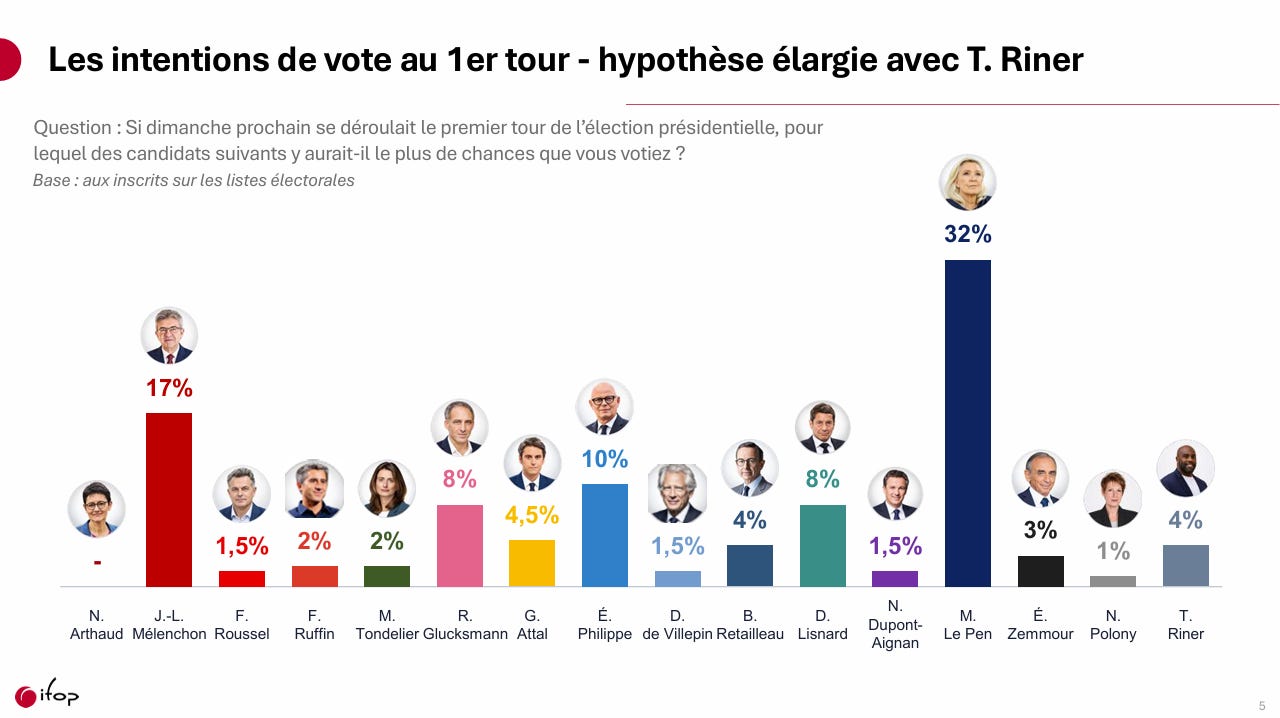
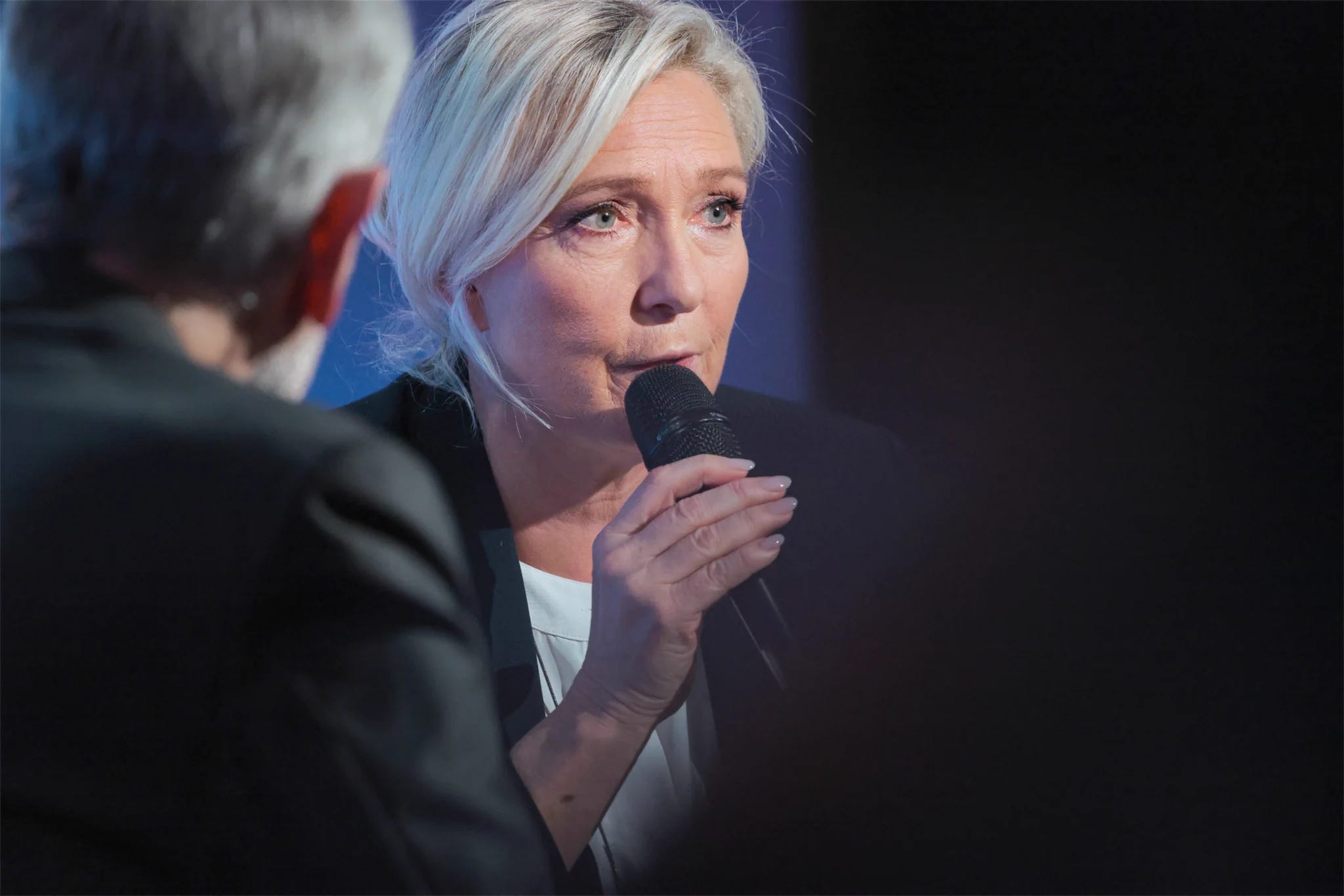
It has Marine Le Pen on 32 to 36% depending on the scenario, down a point or two compared to late October, and Jean-Luc Mélenchon on 17 to 19.5%, up by roughly the same margin. The pair reach the second round in every configuration tested, with Mélenchon between 4 and 8 points clear of whoever finishes third. Sud Radio’s assessment of everyone else (“the right and the centre remain fragmented”) is putting it kindly.
Underneath, nearly all the movement is in one place: Édouard Philippe has stopped falling for now, landing between 10 and 15% with changes of +1.5, −1 and zero across the scenarios Ifop can compare with October.
David Lisnard, on his side, continues to climb, moving up 2 to 3.5 points to between 8 and 12%. Raphaël Glucksmann sits between 8 and 11.5%, and Bruno Retailleau hasn’t budged from 4 to 7%. Gabriel Attal manages between 4 and 4.5% with Philippe in the race and 9% without him, which tells you exactly whose voters he’s waiting for.
Where the votes go.
Ifop also asked where each right or centre candidate's voters would go if that candidate dropped out. Without Philippe, 42% of his voters head to Attal and only 7% to Le Pen. Retailleau's electorate is far less reliable: a third would switch to Le Pen, compared with 39% for Lisnard. Without Lisnard, 19% of his voters go to Le Pen and another 10% to Éric Zemmour.
Teddy Riner gets a paragraph of his own, with the five-time Olympic judo champion announcing his candidacy on 9 November in a video and an interview with Le Parisien, declaring himself neither left nor right and being harpooned as a Macronist almost immediately.
A week later, Ifop has Teddy Riner on 4%, level with Retailleau and half a point behind Attal, while Elabe puts him on 4.5%, ahead of both. A man who still has 500 sponsorships to collect is running neck and neck with a former prime minister and the president of Les Républicains, which probably says more about them than about him.
Though it could also be seen as a repudiation of the political class, too.
The figure that should worry the bloc central most isn’t in the headline tables, however.
Ifop finds that 88% of Le Pen’s voters and 85% of Mélenchon’s are sure of their choice, against 47% for Philippe and Attal and 44% for Lisnard. The two finalists are sitting on locked-in electorates, while everyone fighting for third is only borrowing theirs. Soft support can consolidate quickly behind a single candidate, but a few bad weeks can drain it just as fast as we saw with Philippe’s crash from c.20% voter intention to his current numbers.
Going back to the centre primary and Philippe’s gamble, one Ifop scenario raises a few questions: without Philippe in the running, Glucksmann and Lisnard tie at 11%, and Elabe has Glucksmann narrowly ahead of Philippe in one configuration. This matters to the centre-right because a Retailleau aide told LCP that a 22% Mélenchon in December would trigger panic and hurry the primary along.
The trend suits the RN nicely: in September’s Ifop wave, Le Pen beat Mélenchon by 69% to 31% in a run-off, against 57% to 43% over Philippe.
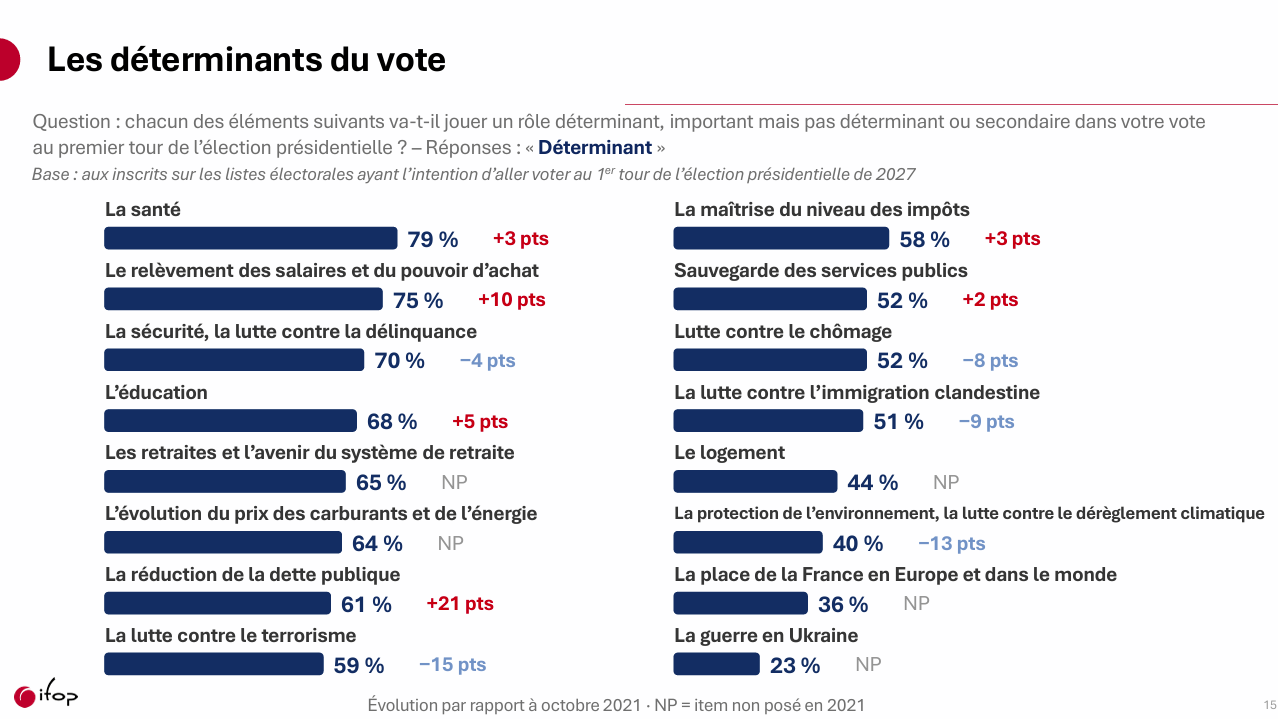
A polling question on what is determining people’s votes is also giving us some interesting information: Compared with October 2021, reducing the public debt has jumped 21 points, with 61% of voters calling it a decisive part of their vote, and it’s the top concern of Lisnard’s electorate at 87%.
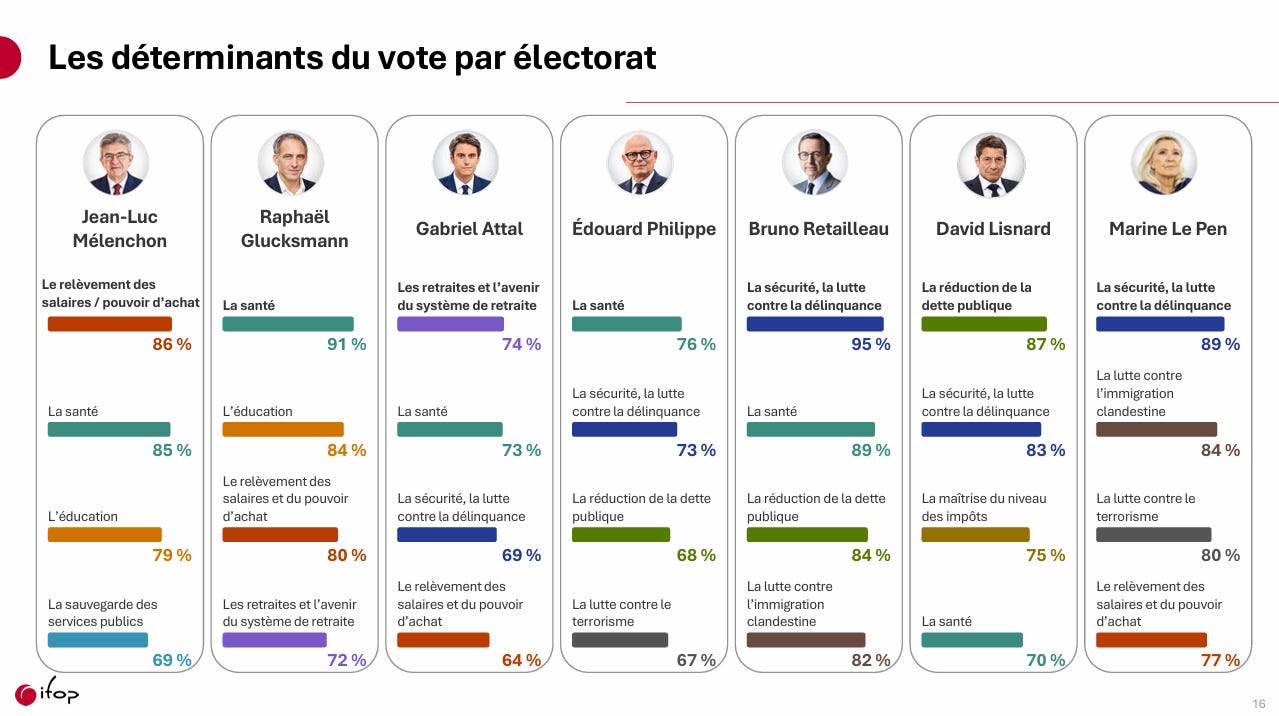
Retailleau’s voters, by contrast, put security first at 95%, and Philippe’s put health first. Any primary winner would have to hold together a debt-hawk electorate, a law-and-order one and a centrist one. On Ifop’s own transfer figures, if the wrong man wins, a sizeable share of the losers’ voters will simply walk across to the RN.
Thank you for reading the French Dispatch! If you liked what you read, you should like this post and subscribe to the newsletter by clicking/tapping the button below:
And if you’d like to contribute a coffee or two to help fuel my coverage of the wild world of politics, feel free to click on the picture below:

Discussion about this post